The Hamilton Community Foundation and The Hamilton Spectator co-hosted a public event ahead of the 2026 municipal election. The goal was to learn directly from residents about the issues shaping their choices in this election, and to share those ideas with candidates and the broader public.
The event included a panel with editors of The Hamilton Spectator and community organizations Hamilton Regional Indian Centre, Social Planning and Research Council of Hamilton and Empowerment Squared.
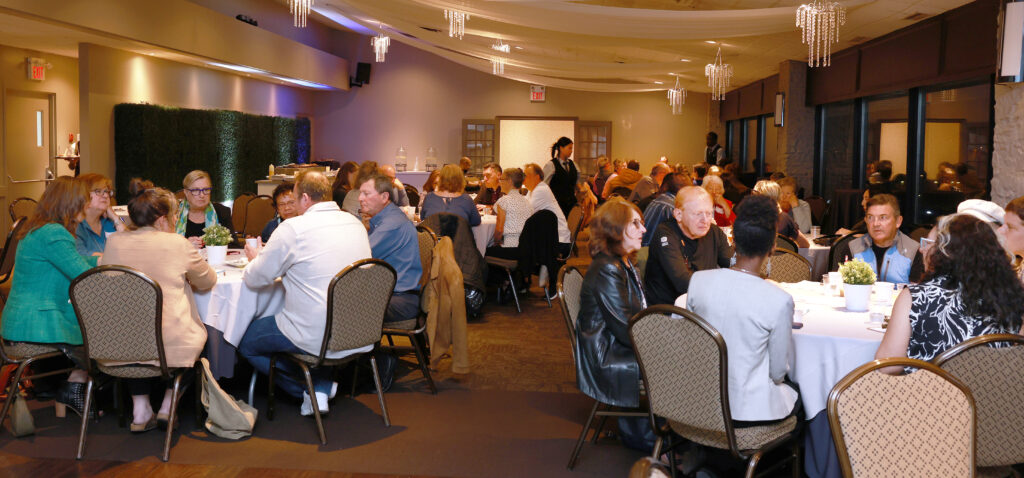
The 80 attendees included small business owners, seniors, parents and families with children, Indigenous community members and leaders, staff of community organizations, and people with lived experience of housing and affordability challenges. Some election candidates also attended as listeners, providing an opportunity to hear directly from residents.
Three broad themes stood out to participants as being both important and insufficiently addressed on the campaign trail. We posed three questions to mayoral candidates about how they would address these issues. The responses were published in the Hamilton Spectator.
What we learned
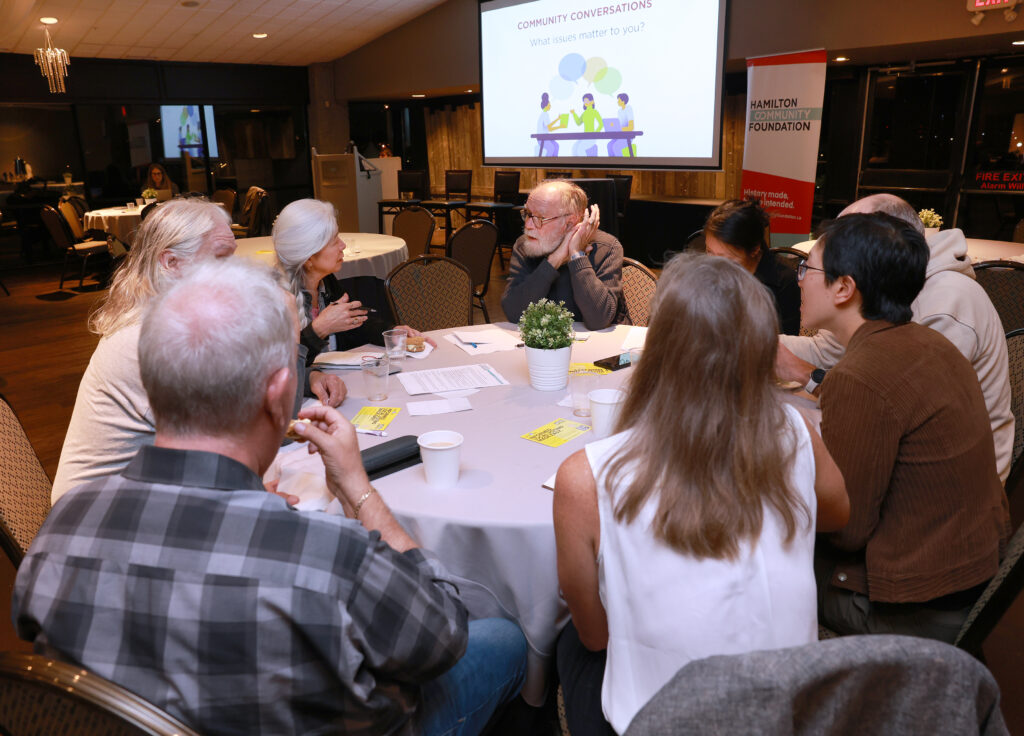
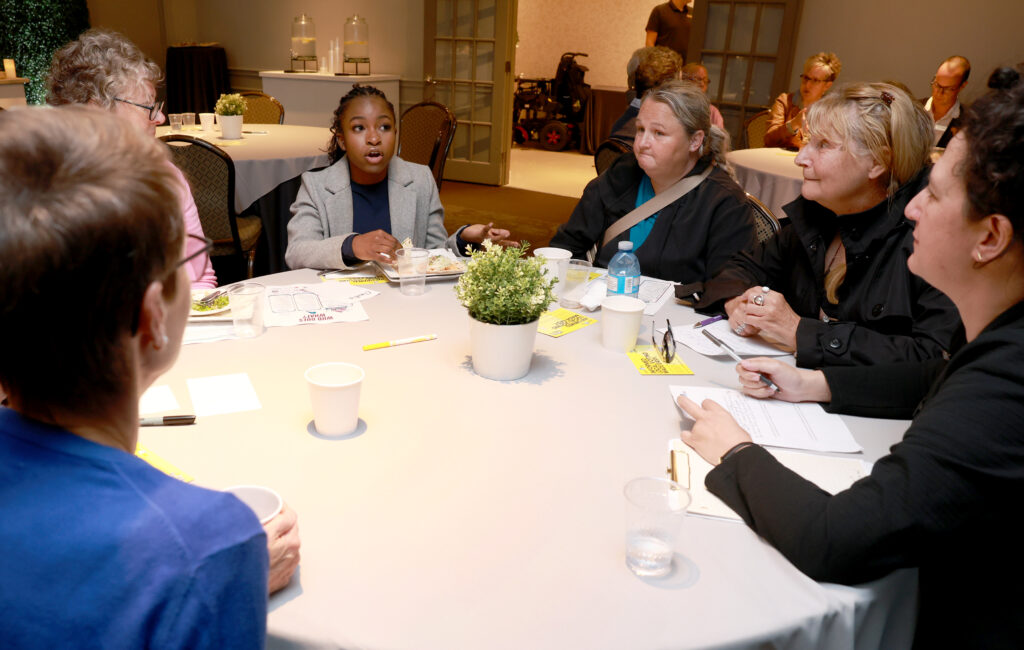
The facilitated table discussions with residents covered three questions related to Hamilton’s future: the single most important issue that elected leaders should focus on; challenges that residents, their families or communities are experiencing which are not getting enough attention from decision-makers; and one key question they would pose to candidates.
The engaging table conversations provided space for curiosity, criticisms and connections, drawn from lived experiences and shared- and differing- opinions. Sixteen themes emerged, ranging from the cost of living, animating city life, belonging and safety, accountability to residents, infrastructure, housing, and more.
Democracy and the big picture
Elections are one part of civic engagement and an opportunity to exercise our democratic voice. Participants made clear they expect the next Hamilton City Council to lead, listen and work with the community to deliver meaningful, measurable progress after election day.
Helping residents make informed choices at the ballot box is part of that broader civic engagement. HCF is pleased to support Vote Compass for this election—an interactive survey designed by political scientists that shows how voters’ views align with candidate platforms. HCF will continue to follow progress alongside residents and track what gets done, to hold elected officials accountable. We are committed to creating spaces regularly for these connections and conversations, not just in election years.
What residents described: Residents described a lack of clear City responsibility and approval processes for accessibility measures, leaving citizen volunteers to fill important gaps.
What residents want to see: Residents called for dedicated AODA compliance and digital accessibility officers, a better-connected transit network that works for wheelchair users, and clearer communication about available resources.
Question for municipal candidates: How will you establish clear responsibility for accessibility, improve accessible transit connections and ensure residents can find the supports available to them?
What residents described: Residents described limited access to councillors, unclear information about progress, red tape, rising costs and concern that public feedback is not reflected in political decisions. They questioned whether high-profile initiatives are producing results.
What residents want to see: Residents want transparent spending and procurement, measurable public reporting, less waste, collaboration across systems, learning from other jurisdictions and candidates who represent the whole community.
Question for municipal candidates: What are your priorities, how will you keep your promises, and how will residents track progress and hold you accountable?
What residents described: Residents said rising rents and everyday costs are hitting seniors, young people and families hard. Young people feel they are doing everything right but still cannot get ahead and may leave Hamilton; residents also identified gaps in employment supports in the transition from school to work.
What residents want to see: Residents want attention to living wages, pathways into employment and jobs that allow people to live and work in Hamilton.
Question for municipal candidates: How will you support good local jobs and affordability so people of different ages and incomes can build a future in Hamilton?
What residents described: Residents noted hate directed at 2SLGBTQI communities, rising antisemitism, neglected neighbourhoods and the exclusion that results when basic needs are not met. They recognized that these challenges extend beyond municipal authority.
What residents want to see: Residents want more free, accessible youth activities and sports, stronger social connection and attention to neighbourhoods and communities that feel left behind.
Question for municipal candidates: How will you make Hamilton socially healthy, inclusive and safe while addressing hate and unequal access to opportunity?
What residents described: Residents described a weakening social fabric, uneven sense of belonging among community members, tension between revitalization and gentrification, and planning that does not consistently create connected neighbourhoods or welcoming public spaces. Residents raised questions about the local impacts of AI data centres, including demands on servers, water supply and other infrastructure. Some felt Hamilton no longer lives up to its identity as the “ambitious city.”
What residents want to see: Residents want an inclusive Hamilton with nearby services, addressing “food deserts” and better access to grocery stores, nature and gathering places; better collaboration across sectors; environmental and infrastructure impacts of AI to be assessed transparently when the City considers procurement; and greater use of proven ideas and local expertise.
Question for municipal candidates: What is your vision for an inclusive, connected Hamilton, and what municipal actions will move the city toward it?
What residents described: Residents described downtown challenges related to substance use, housing, safety and public perceptions, while also recognizing opportunities created by major events, hotels, restaurants and the TD Coliseum. They also questioned how police funding is being used.
What residents want to see: Residents want a cleaner, safer and more welcoming downtown, revitalization that builds on its assets, and transparent reporting on municipal and police spending.
Question for municipal candidates: How will you support a safe and vibrant downtown, and how will you report whether public spending is producing results?
What residents described: Residents noted declining purchases and pressure on coffee shops and other small businesses.
What residents want to see: Residents want stronger support for small businesses, including help with rents, wages and tourism promotion, as well as conditions that foster entrepreneurship and retain young people.
Question for municipal candidates: How will you attract and support businesses so local entrepreneurs can thrive and young people can live and work in Hamilton?
What residents described: Residents described a lack of welcoming “third spaces” where people can gather outside home and work.
What residents want to see: Residents want more public art, better use of heritage buildings and more places that create activity, connection and civic pride.
Question for municipal candidates: How will you support arts, heritage and welcoming public spaces that bring people together?
What residents described: Empty public housing units, challenges faced by small landlords to maintain buildings, different from large corporations, inadequate supportive housing and competing views about whether the central problem is supply. They noted progress in subsidized housing but also municipal barriers to development.
What residents want to see: Residents want housing treated as a human right, more affordable and supportive options, creative use of existing buildings, support for responsible small landlords and a City approval process that enables rather than delays suitable projects.
Question for municipal candidates: Which municipal housing levers will you use to bring suitable homes into use faster, reduce City barriers and expand affordable and supportive housing?
What residents described: Residents described gaps in recreation, roads, parking, transit and protected cycling infrastructure; concerns about neglected public sites and buildings; uncertainty about LRT timing and cost; and gaps in childcare supports.
What residents want to see: Residents want coordinated and fairly accessible services, safer cycling and transit networks, clearer LRT cost and benefit information, and transparent plans for major sites and infrastructure investments.
Question for municipal candidates: How will you prioritize infrastructure and services, manage LRT costs and timelines, and show that investments are accessible and delivering value?
What residents described: Residents described overdoses, homelessness, crime, youth violence, open drug use, downtown shootings and neighbourhood cleanliness concerns. They also expressed different views on policing, mandatory treatment and the connection between substance use and homelessness.
What residents want to see: Residents want prevention and root-cause responses, housing and supports alongside treatment, dignified approaches that avoid “othering,” and visible improvements such as more garbage pickup.
Question for municipal candidates: How will you improve community safety while addressing homelessness, substance use and their root causes with dignity and measurable results?
What residents described: Residents described entrenched municipal policies, risk aversion, departmental silos, polarization at City Hall and pressure for short-term wins. They also noted the continuing effects of deinstitutionalization and underrepresentation of women, Indigenous and racialized people in municipal government.
What residents want to see: Residents want systemic change, modernized services, more collaboration across departments, compassionate and responsible risk-taking, and broader representation in civic leadership.
Question for municipal candidates: How will you break down City Hall silos, modernize systems and support responsible policy change while remaining accountable to the public?
What residents described: Residents expressed different views on taxation: some connected higher taxes with quality public services, while others emphasized the pressure of increases on household budgets. Across these views, residents wanted confidence that money is used well.
What residents want to see: Residents want clear rationales for tax changes, spending aligned with priorities, efficient use of revenue and exploration of ways to broaden the tax base or generate revenue beyond property taxes.
Question for municipal candidates: How will you fund priorities fairly, demonstrate value for taxes and pursue additional sources of municipal revenue?
What residents described: Residents described a gap between stated commitments to Truth and Reconciliation and the inclusion of Indigenous voices and values in how decisions are made.
What residents want to see: Residents want Indigenous voices and values reflected meaningfully in municipal processes, priorities and actions.
Question for municipal candidates: How will you ensure that Indigenous voices shape City decisions and that municipal actions advance Truth and Reconciliation?
What residents described: Residents described limited consultation, unequal influence in decision-making and concern that opposition from a small number of people can outweigh broader community needs, including housing.
What residents want to see: Residents want consultation that reaches diverse groups, balances interests, demonstrates how input shaped decisions and considers restoring advisory councils.
Question for municipal candidates: How will you consult communities meaningfully and show residents how their input influenced your decisions?
What residents described: Residents reported frustration with responsibilities being downloaded from provincial and federal governments to the municipality.
What residents want to see: Residents want other governments to fund their responsibilities adequately, including ODSP rates that cover rent and basic expenses, while the City advocates clearly for Hamilton’s needs.
Question for municipal candidates: How will you advocate to provincial and federal governments, and how will you distinguish what the City can do directly from what requires action by other governments?
Donations to the Foundation are invested for the long term in public markets and in alternative investments. Investment income is then allocated annually to support granting, community leadership and operations. The summary and charts presented here provide both a financial snapshot and a history of recent activity that underlies the grants and community leadership activities represented in this annual report, made possible by remarkable donors.
Donations to the Foundation are from individuals, corporations and other charities. Donors may contribute to named endowment or flowthrough funds, to the Board-directed Community Fund, or to HCF’s community leadership projects.
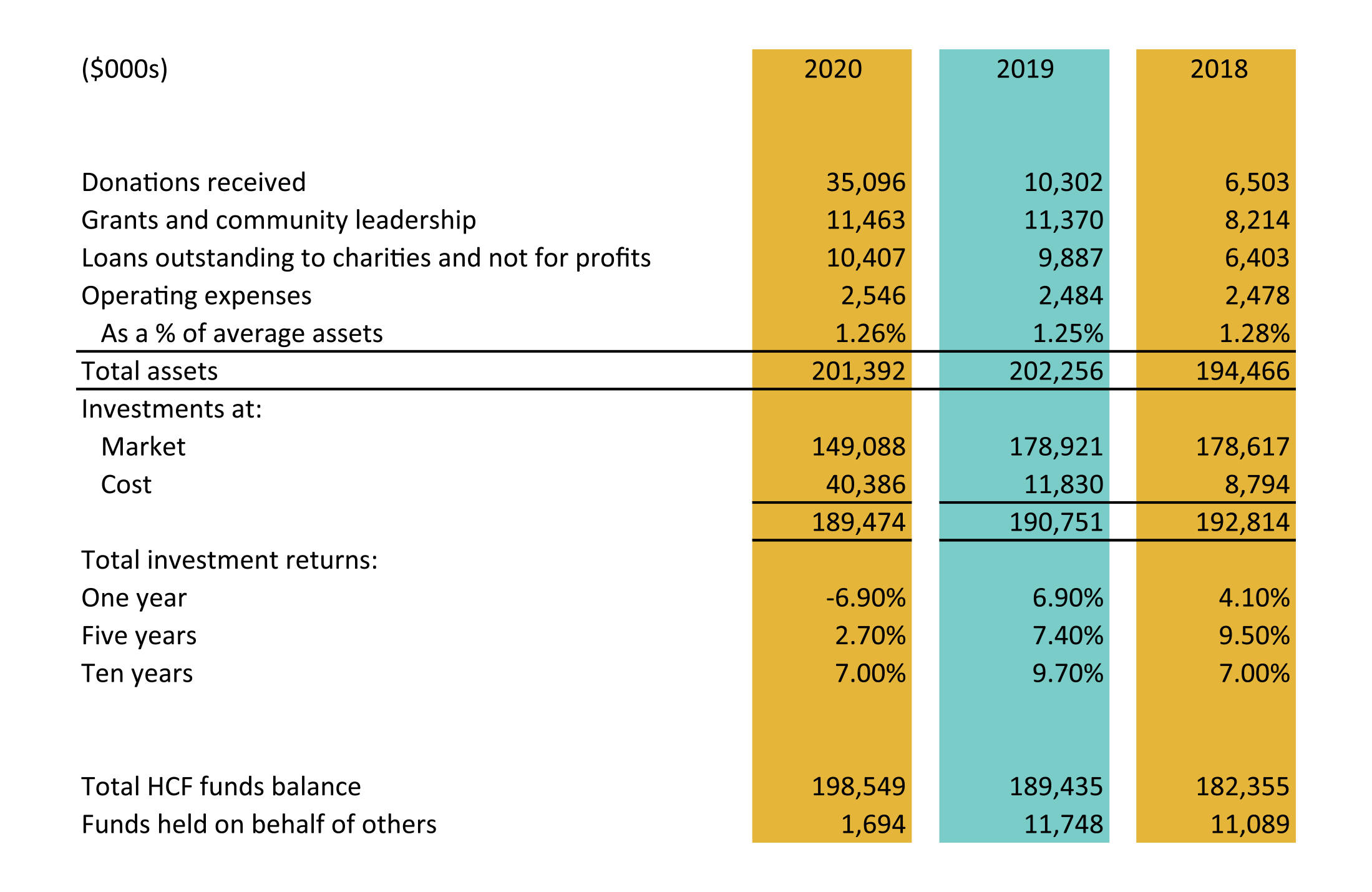
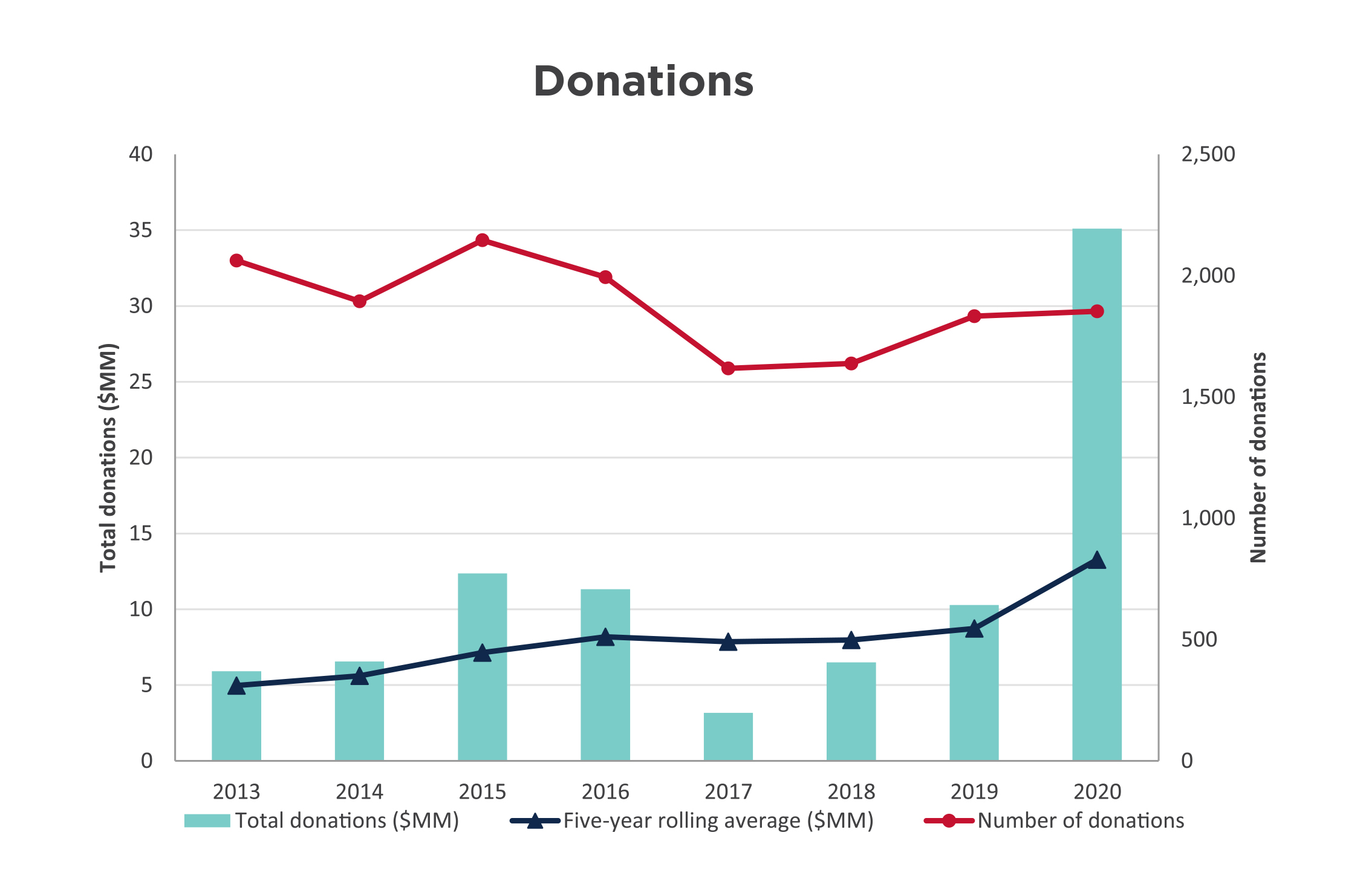
The $35.1 million in donations this year is the second highest total in HCF’s history. Annual donations are influenced by the timing of the realization of donations in wills and significant one-time donations like the $27.7 million in donations of property and private equity. As illustrated in Chart 1, annual donations have ranged between $3.2 and $35.1 million over the past eight years. The five-year rolling average of donations ranges from $5.0 million to $13.3 million over the past eight years.
The five-year rolling average number of donations is 1,787 with 2019-20 at 1,853. The number of donations fluctuates based on “in memoriam” donations and the number and nature of events sponsored by donors to raise money for their funds.
Chart 1
Grants are made annually from both endowed and flowthrough funds. Because flowthrough fund balances are distributed in a shorter time period, granting from these funds can materially influence HCF’s total annual amount granted.
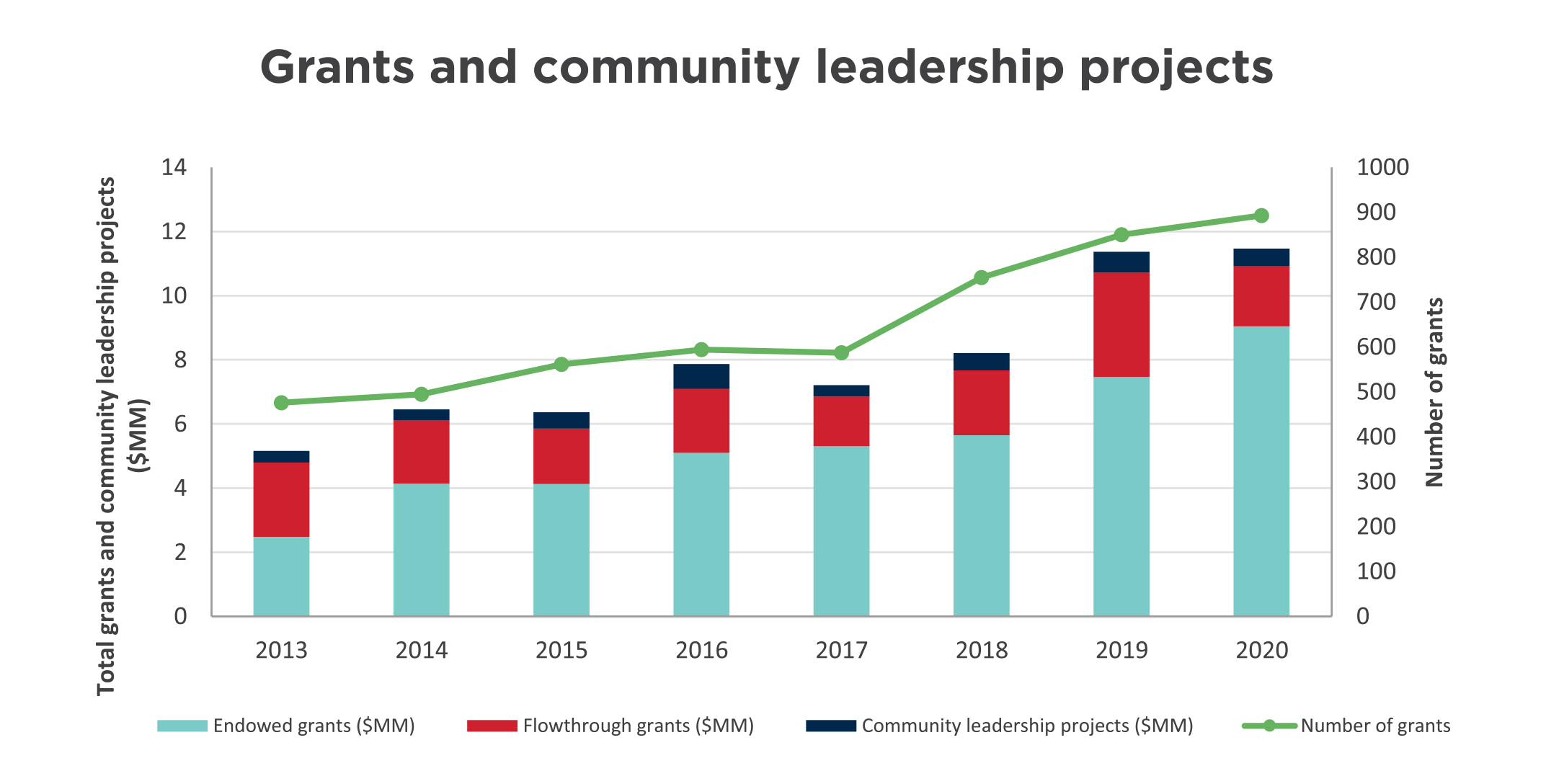
As illustrated in Chart 2, grants and community leadership project spending over the past eight years has ranged from $4.7 million to this year’s historic high of $11.5 million. Granting from endowment funds was reduced in 2013 as a result of the decline in investment returns in 2012 which a) lowered the asset base used for the granting calculation (currently four percent of the fund balances), and b) resulted in less income available to grant. Flowthrough granting and expenditures on community leadership projects has ranged from 22 to 56 percent of total granting in any given year and is dependent on the timing and nature of flowthrough and project activity. At 893, the number of grants for this year is 37 percent higher than the eight-year average.
Chart 2
Investments traded in active markets are reported at fair market value. Investments not actively traded are recorded at their cost less any impairment of their value.
To support our strategy of aligning our assets with our mission and to provide a more diverse and robust portfolio, HCF has committed to investing in alternative asset classes including loans to charities and not-for-profits, private debt, real estate, infrastructure and private equity. These alternatives are consistent with the Foundation’s long-term investment horizon and liquidity requirements. Since these investments are not actively traded, they are valued at cost in the investments. These alternatives total $25.8 million.
HCF invests according to policy guidelines established by the Board of Directors. Two committees of the Board oversee investments to ensure compliance with the policy:
As an endowment builder, HCF’s policy focuses on long-term investing and is supported by reserve accounts that are currently at their policy maximum.
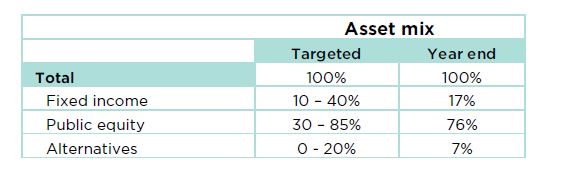
The investment policy sets out a total portfolio target asset mix, as well as a range around these targets. The public market investment managers have mandates within this targeted asset mix and use their discretion to invest the portfolios within this range. Chart 3 reflects the current and target asset mix. Note: $25 million of private equity relates to a fund established by a donor and is not part of the asset mix or the consolidated portfolio results.
Chart 3
Two long-term portfolios are invested in the public markets with Jarislowsky Fraser, and Connor, Clark & Lunn. Chart 4 compares those portfolios against benchmarks as follows:
Benchmarks reflect the performance of each market index based on HCF’s specific target asset mix. Comparing actual results to the benchmark measures the value added by investment managers compared to the average market performance. HCF’s investment policy target is a long-term investment return in the 6.5 to 7.5 percent range.
Chart 4
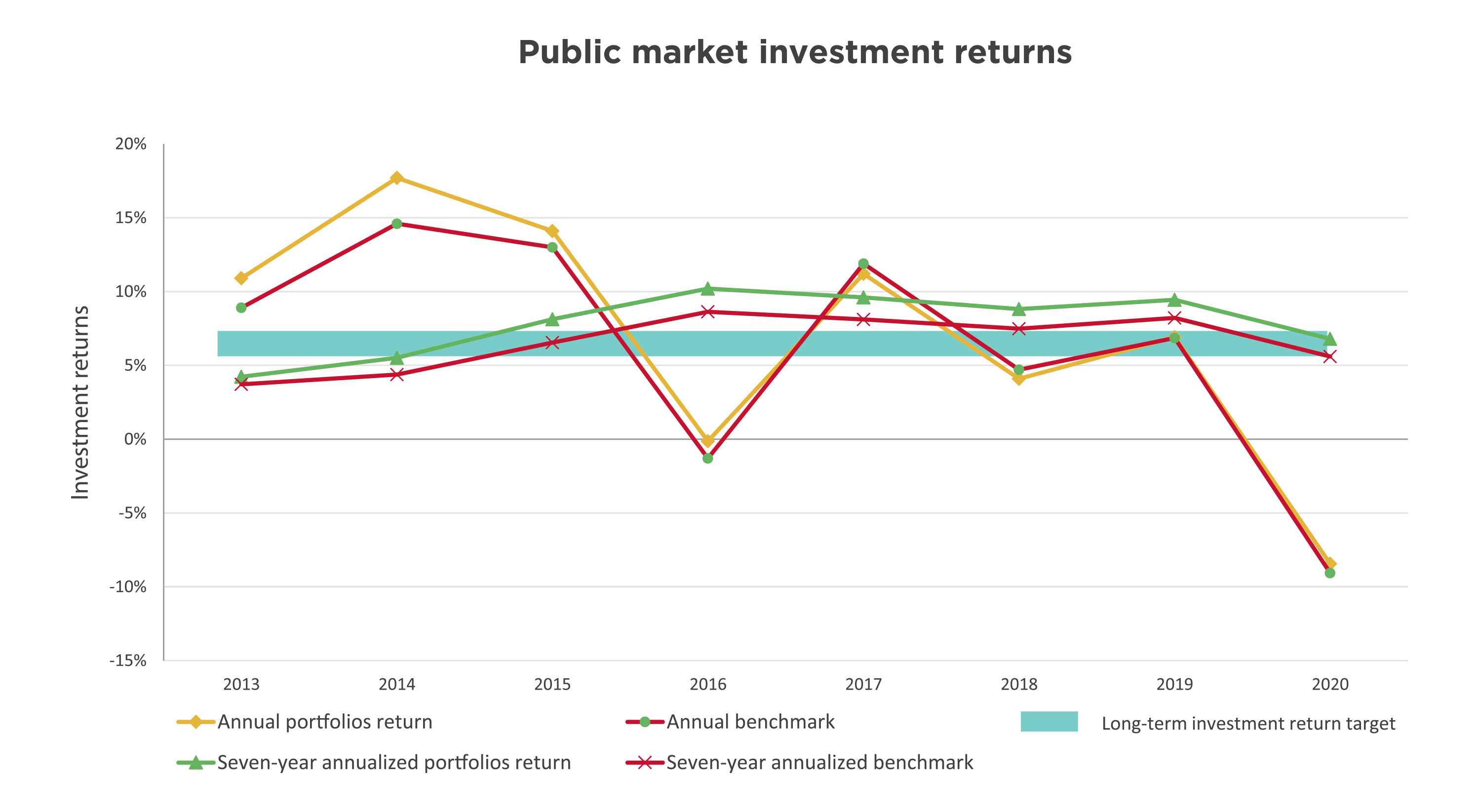
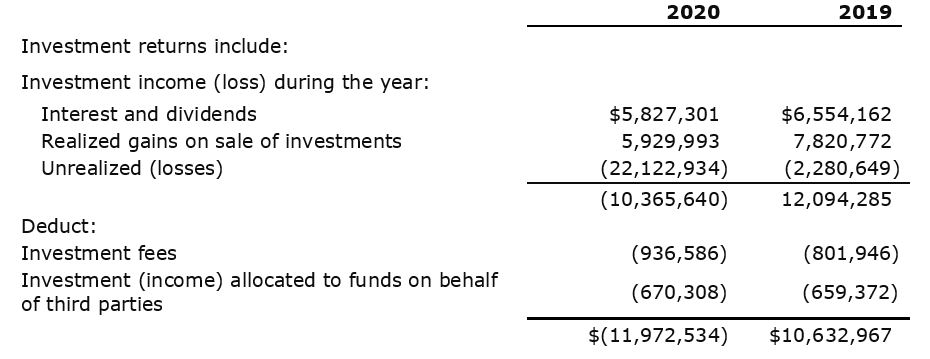
The effect of the global pandemic has materially affected investment returns, resulting in a -8.4 percent public market return for the year. The seven-year annualized return at 6.8 percent is within the targeted investment policy range and is 1.2 percent higher than the 5.6 percent benchmark. As noted in the financial highlights, the current 10-year annualized return of 7.0 percent is in the target range and is higher than the benchmark by 1.2 percent.
Impact investments enable donations to endowed funds to drive positive change beyond granting, because they represent investments of capital that deliver financial returns coupled with positive social and/or environmental outcomes. In addition, these investments provide a pool uncorrelated to the public markets which, in turn, buffers the portfolio from the volatility currently experienced.
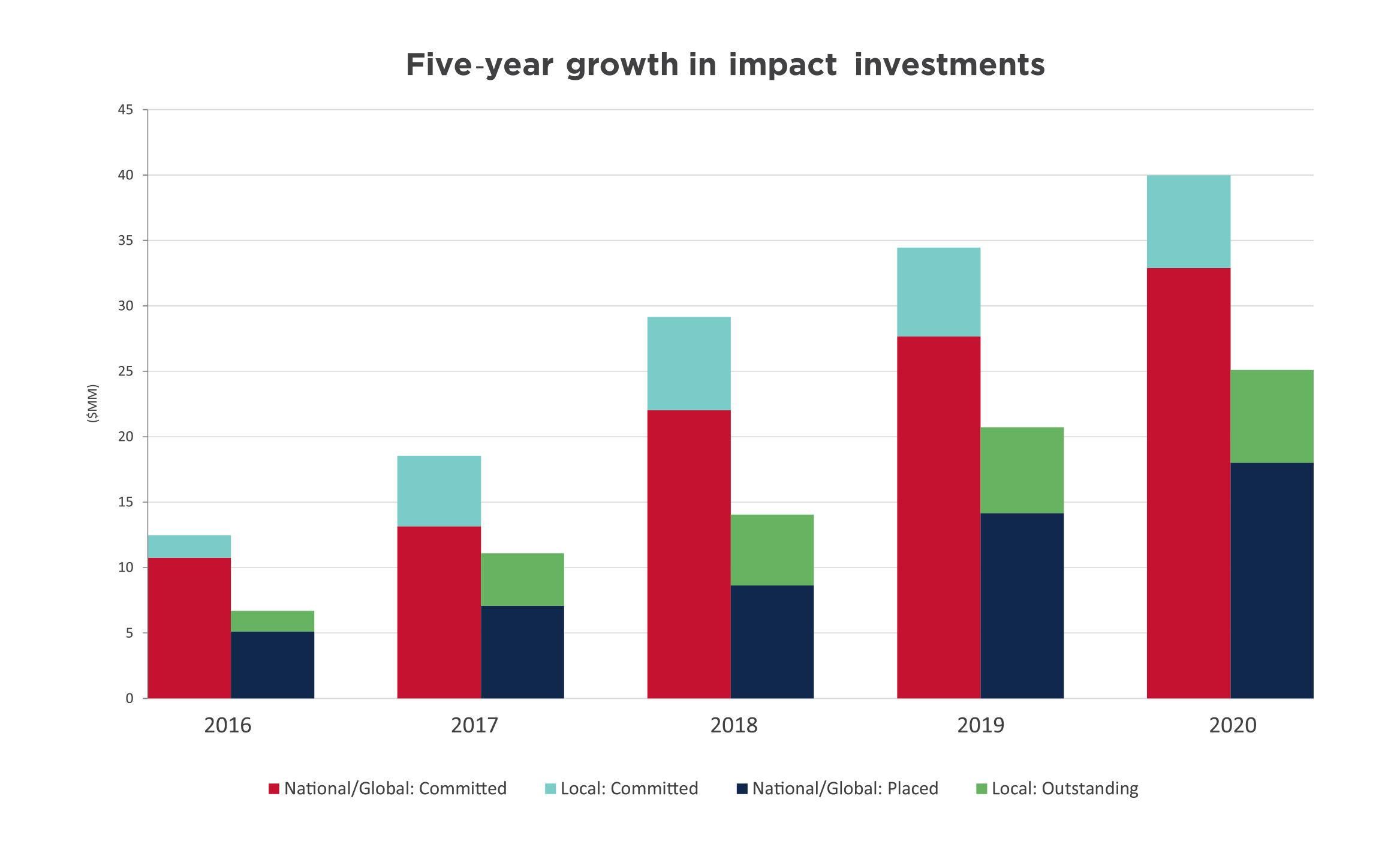
More than 15 percent of our long-term assets are in impact investments. Chart 5 illustrates HCF’s impact investing progress over the past five years, with $25 million currently placed or outstanding and another $15 million committed. This brings the total commitment to $40 million, up from $34 million last year. Impact investments cover areas including affordable housing, arts, environment and sustainable development.
Chart 5
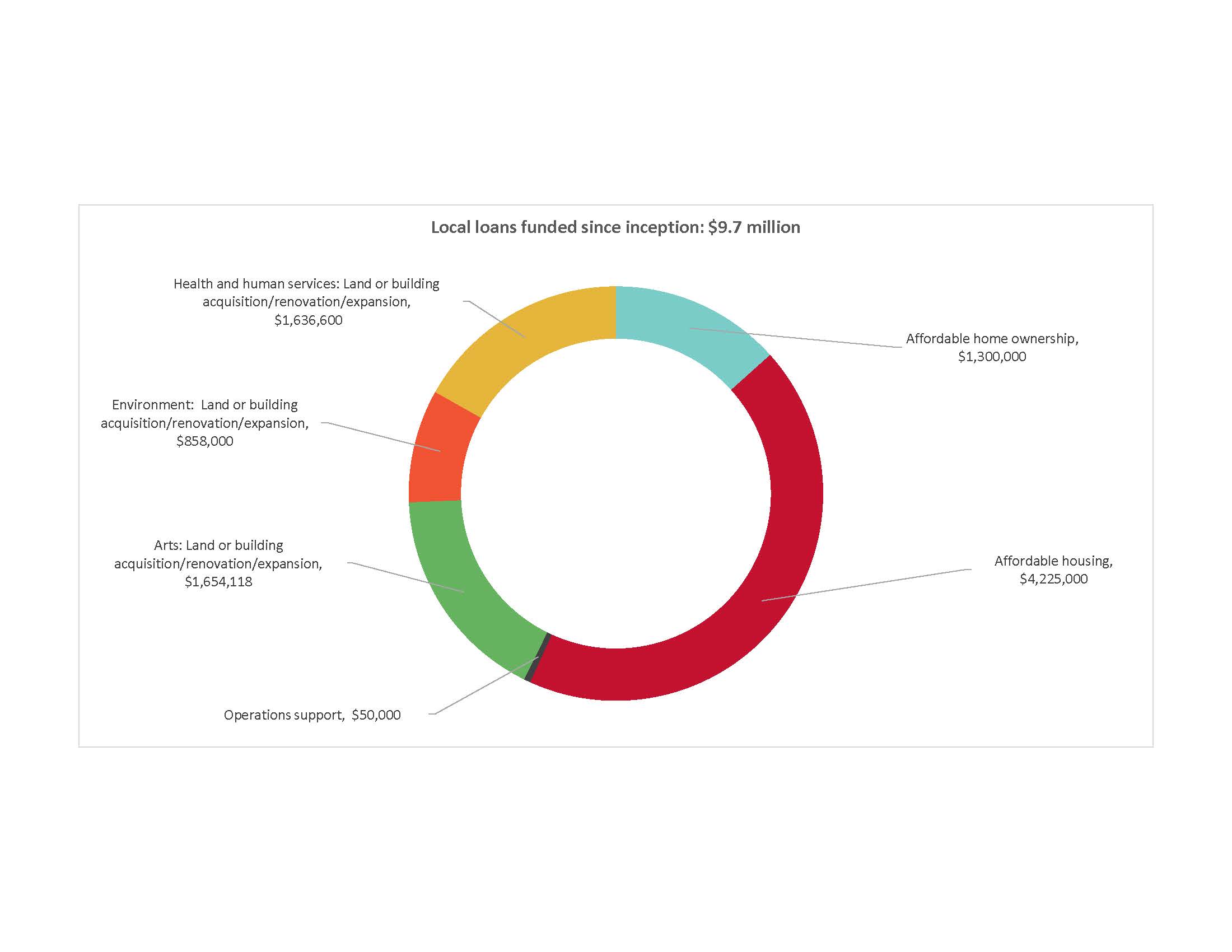
Local loans since inception total $9.7 million with $7.1 million outstanding at year end. Chart 6 shows the impact areas our loans have supported. Since the loan program’s 2012 inception, $2.6 million in loan principal has been repaid and recycled as new loans. In addition, the interest from these loans supports HCF granting.
Chart 6
IRP is a Government of Canada program being delivered nationally by partners including Community Foundations of Canada. As the first phase in the government’s long-term investment in social finance, the IRP’s goal is to make social-purpose organizations “investment ready” so they can make a difference in new and innovative ways through their participation in the social finance market. HCF has partnered with community foundations in London and Niagara, and the McMaster Innovation Park to manage the program regionally on behalf of Community Foundations of Canada. The first request for proposals for funding in January created enormous interest nationally and garnered 65 submissions to our regional partnership. Approved funding is expected to be released in June 2020. As an additional benefit, the IRP brought a growing number of potential opportunities for local loans to HCF’s attention.
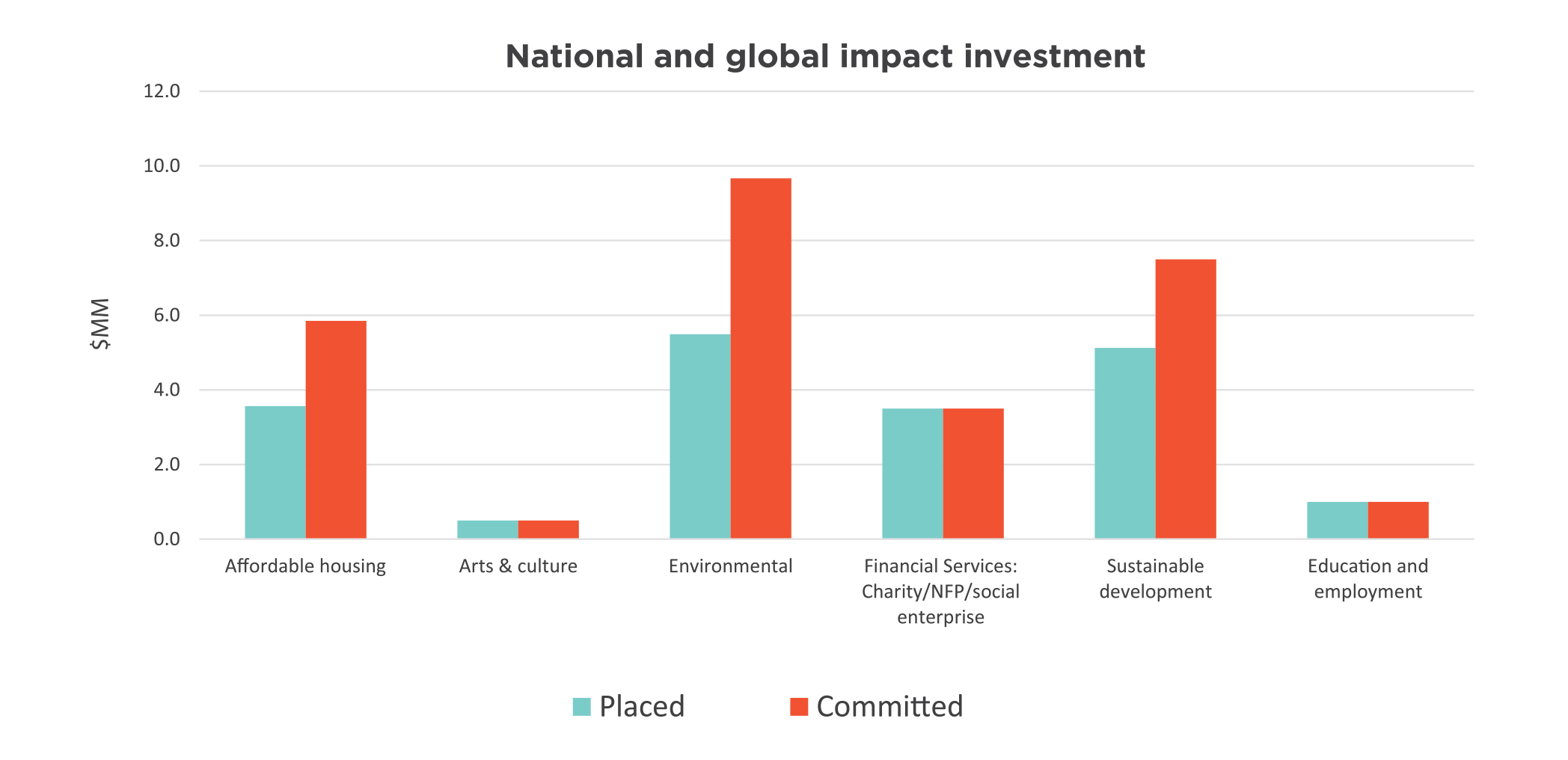
These investments include private equity, private debt and real estate investments. Many of these investments are long term in nature, are maintained at cost and do not have a regular income stream. As these investments are maintained at cost, their results include interest income and realized gains, but not unrealized gains. Results for these investments are closely monitored and are reported when realized. Chart 7 identifies the investment areas, with $18.0 million placed and a total commitment of $33 million across 21 investments.
Chart 7
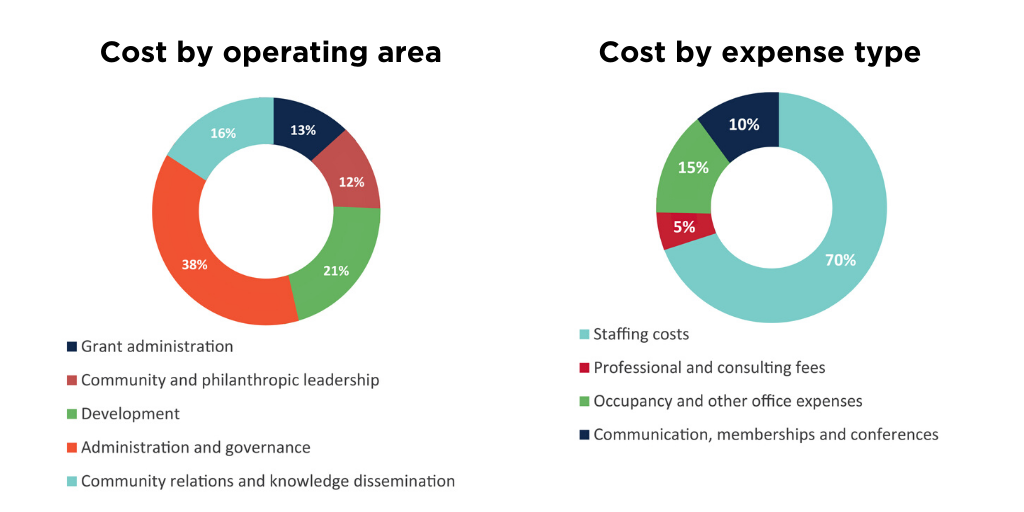
Operating expenses for the fiscal year ended March 31, 2020 total $2.5 million and were 2.5 percent higher than last year. Staffing costs related to the Foundation’s 22 employees represent 70 percent of HCF operating costs.
In addition to breaking out cost by type, operating costs are allocated to each of the Foundation’s operating areas: grants administration, community and philanthropic leadership, community relations and knowledge dissemination, development activities, and administration and governance. Examples of community and philanthropic leadership include convening around the city’s critical issues and fostering the growth of philanthropy by sharing staff time and knowledge to support other charities. Charts 8 and 9 illustrate these costs by operating area and by expense type.
Charts 8 and 9
The Foundation’s annual development expenses are not necessarily attributable to the donations received in that year. The nature of donations to the Foundation can result in costs preceding the receipt of the donation by several years (for example, donations through wills). As a result, consistent with the community foundation sector, operating costs are evaluated by a ratio of total operating expenses to average total assets. Ratios fall within a range depending on the size and stage of the community foundation’s development.
Management considers the ratio of 1.26 percent (1.25 percent in 2019), as illustrated in Chart 10, to be within an acceptable range for a foundation of HCF’s size, stage and level of community leadership, compared against benchmarks established in the community foundation sector. We continue to monitor both the actual results and the benchmarks on an ongoing basis.
Chart 10

Hamilton Community Foundation’s total assets of $201 million at March 31, 2020 include balances of HCF funds and funds held on behalf of others at $1.7 million.
Hamilton Community Foundation’s fund balances, illustrated in Chart 11, represent accumulated donations plus the net investment earnings on these donations, minus granting and operating costs. Funds include both endowed and flowthrough funds. Endowed funds are held permanently and grant from investment earnings. Flowthrough funds are fully distributed as grants over a pre-determined term.
Chart 11
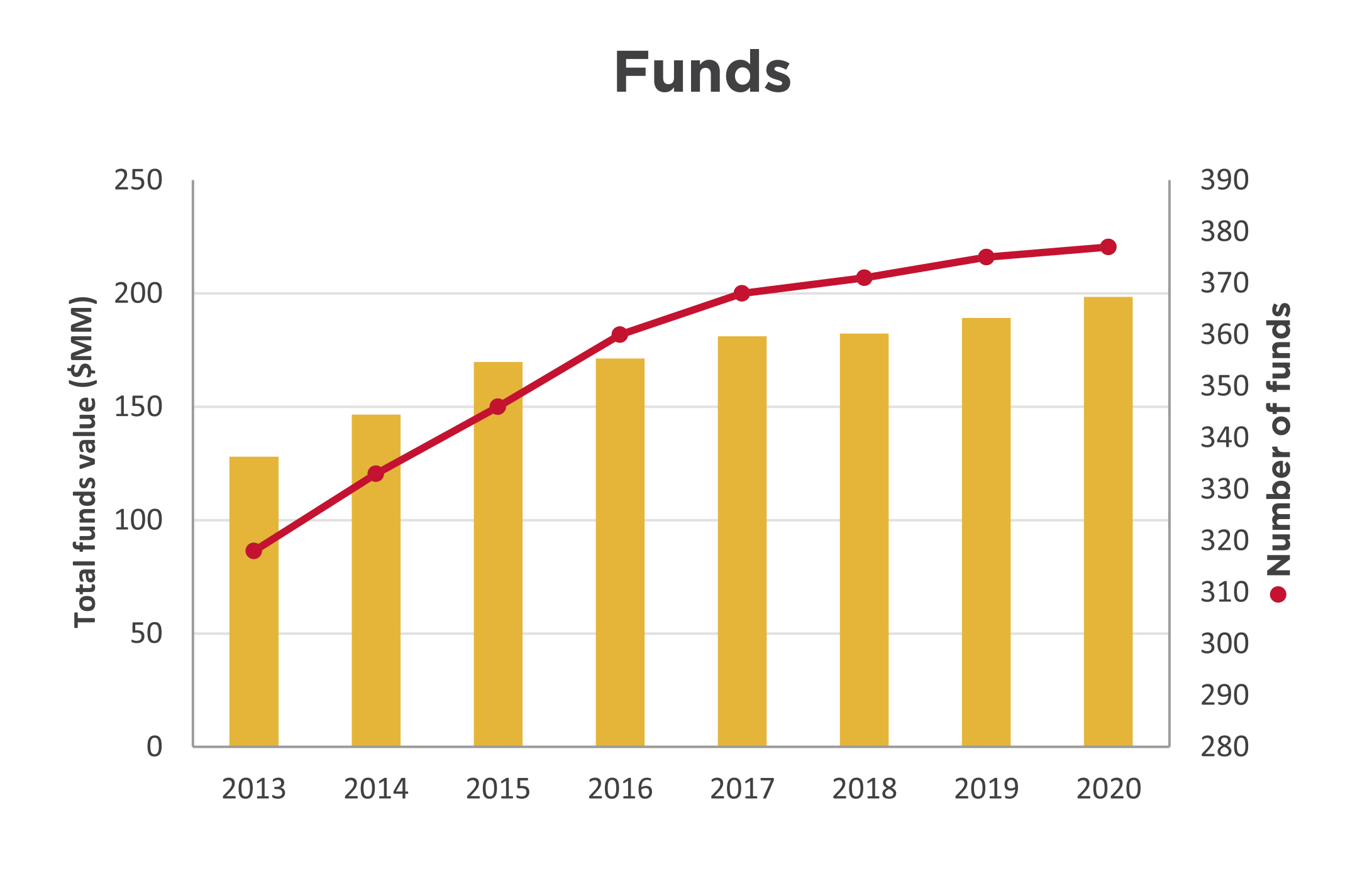
The fund balances have grown 55 percent to $198 million at the year ended March 31, 2020 from $128 million in 2013. Donations of $35.1 million included $4.4 million in flowthrough donations that were largely distributed as grants in the year and, as a result, do not remain in the fund balances at year end. This results in a modest total funds balance growth of 4.8 per cent for the year. The number of funds has grown 19 percent to 377 from 318 in 2013.
 Donate Today