As a charitable sector CEO, I am appropriately restricted from participating in any partisan political activity. But as a longtime political junkie and former Regional Chairman, I remain vitally interested in the the process and deeply concerned about our democratic deficits that go way beyond the ballot box. On the eve of tomorrow’s Provincial Election in Ontario, I wanted to share this Spec Column that I penned some time ago, remembering my friend and former Hamilton East M. P.P., the late Dominic Agostino. Dom always ensured that local elections were fun. They aren’t quite the same without him. And please don’t forget to vote.
“It is said that God gave us memory
so we could have roses in winter.”
– George Will
I am sentimental by nature. With three children under
five, I get to witness the pure joy of Christmas through young eyes. But it’s
also a time of year to reminisce about those we’ve lost.
The period between Christmas and New Year’s triggers
in me memories of Dominic Agostino. Every year at this time, he would organize
what we referred to as Dominic’s Excellent Adventure. It was an annual night
out in Toronto. The guest list included five or six elected officials of all
stripes. The only qualification, Dominic insisted upon was a willingness to
endure some gentle teasing.
The evening started at Dominic’s apartment just off
Bay Street in the financial district. Martinis were served before a cab ride to
a local theatre. Dominic always chose a movie with a political theme to ensure
we were prepped for the discussion to follow.
After the film, the party proceeded to the Keg
Mansion. The objectives were simple: to consume lots of good food and red wine
and then to tell political tales long into the night. Sadly, it’s a tradition
that ended with Dominic’s untimely passing almost three years ago at the age of
44.
Cynics have said that if you want a friend in
politics, buy a dog. But Dominic rejected that notion completely. He collected
friends almost as assiduously as election victories.
I first met Dominic in high school. He played football
at Cathedral at the same time I was playing basketball at Westdale. By
coincidence, we both started our careers as social workers with the March of
Dimes. Working from the same small office on Woodward Avenue, we shared a
passion for politics and sports and became good friends.
A friendship with Dominic came with an added bonus:
the love and great cooking of his mom, Teresa.
You quickly realized that for the Agostinos, loyalty
to family and friends was compulsory. They insisted on providing help and
hospitality even when you didn’t need it.
Despite Dominic’s unfortunate attachment to the
Liberal party, I campaigned for him in each of his elections. That loyalty was
returned in spades, although when campaigning with me he sometimes muttered
about my Tory leanings. For Dominic, partisanship never came before friendship.
First elected to Hamilton’s Catholic school board at
age 21, Dominic remained an elected official for the rest of his life. He
climbed the political ladder from the school board to city council and then to
Queen’s Park. He surely would have made it to Ottawa had his career not been
cut short.
Dominic’s approach to politics was unique. He said it
was show business for ugly people and admitted he’d never met a microphone he
didn’t like.
He was a master at turning trivia into front-page
news, but you always knew that you were in on the joke and that on important
issues, Dominic would not disappoint.
Incapable of malice, Dominic was frequently subjected
to political ridicule and cruel whispers about his personal life. He invariably
responded with quiet dignity and a disarming smile.
Dominic’s relatively short life taught us many
lessons, not the least of which is the importance of civility in life generally
and in politics particularly.
He had the ability to disagree without ever being
disagreeable. This and his innate generosity allowed Dominic to make and keep
many friends from across the spectrum, both in and out of politics.
On New Year’s Eve, I toasted the memory of Dominic
Agostino. His was a life well lived.
Is art the “new steel”, as the saying goes?
In Hamilton, many people argue that the arts will be a primary driver of economic growth in coming years as the city economy shifts away from heavy manufacturing to creative and knowledge industries. With the rapid growth and popularity of arts festivals like last weekend’s Supercrawl on James North, it’s clear that the arts are making a real impact.
In fact, the upcoming Vital Signs 2011 Report notes that 44 percent of Hamiltonians attended a cultural event in 2010, higher than the 39 percent average in other Vital Signs communities.
At the same time, we would be wise not to discount our manufacturing heritage just yet. According to employment data we will be publishing in upcoming upcoming Vital Signs report, employment in the goods-producing sector, which includes manufacturing and construction, has grown by 5.5 percent in the past three years. In contrast, employment in the service sector grew by 3.9%.
One of the more promising areas is the intersection of knowledge and manufacturing. It’s easy to assume we should jump on the “web startup” bandwagon, but Hamilton has a unique ability to leverage our existing industrial manufacturing capacity into innovative new businesses that make things.
With easy access to the Greater Toronto and Hamilton Area, Hamilton could become an economic bright light that grows new businesses from the ground up and produces jobs that pay well enough to keep their employees out of the unfortunate ranks of the working poor.
Who knows: one of the 800 startups expected to launch by the end of this year could grow into a major employer. Initiatives like the Lion’s Lair , started by the Chamber of Commerce and Innovation Factory, can help foster the entrepreneurial culture that is necessary to grow lots of new businesses.
In fact, we are so optimistic about the role of investing in building stronger communities that Hamilton Community Foundation has launched a community investing initiative to leverage our capital more directly and proactively.
So I arrived in Winnipeg last night and as chance would have it the Jets were playing their first NHL game since the tragic departure in 1996. As a sports junkie I figured I had to take a shot even though the game was sold out and I had no ticket. I arrived at the start of the second period and the ticket wicket was closed and scalpers had gone home. Standing pathetically at the front gate I explained my situation to a kind ticket taker. Taking pity on me she got me a free ticket in Row#6 from a “friendly Manitoban”. I then had a guy sitting next to me who was intrigued by my story buy me a beer and a hotdog. The last two periods produce a raucous 6-1 win for the Jets and the crowd sounded like they had just won a Stanley Cup. What a great city! Hope to do the same thing soon in the Hammer….
A busy day on tap at HCF with our jam packed first Board meeting of the fall, under the capable watch of our new board Chair, Dr. Gary Warner. We welcome an outstanding group of new board members including Mac President Dr. Patrick Deane, Lawyer and community volunteer extraordinaire Brent Foreman and dynamic young entrepreneur Paul Lee Chin.
Immediately after the Board meeting I will dash to Hamilton Airport for a flight to Winnipeg. I am presenting there, along with some outstanding speakers from the U.K., U.S.A. and Canada, at the Philanthropy, Law and Social Enterprise Conference hosted by my friend and mentor Rick Frost of the Winnipeg Community Foundation. The audience will be predominately law students as well as community foundation partners and I always enjoy the opportunity to speak to the leaders of tomorrow about the power of philanthropy and some of exciting and innovative work that our team is doing at HCF.
We attended the first ever Lion’s Lair at Carmen’s last evening and it was an unqualified success. In addition to a packed house, the energy was palpaple and the stories of the competing entrepreneurs were inspiring. Creating a culture of innovation in Hamilton has been a passion of my friend Mark Chamberlain (and former HCF Board Chair) for many years and his positive spirit writ large at the event. Congratulations to all of the contenders and especially the winners. Thanks also to Ron Neumann at the Innovation Factory and David Adames at the Chamber for the combined efforts of their organizations (plus many corporate sponsors) to make it happen. I am also proud of the leadership provided by numerous HCF Board members including Demet Tsafaridis, Marita Zaffiro, Ruth Liebersbach and “Lion” and host, PJ Mercanti. Well done gang!
“Here’s why: learning is hard. True, learning is fun, exhilarating and gratifying — but it is also often daunting, exhausting and sometimes discouraging. . . . To help chronically low-performing but intelligent students, educators and parents must first recognize that character is at least as important as intellect.”https://www.nytimes.com/2011/09/18/magazine/what-if-the-secret-to-success-is-failure.html?pagewanted=3&_r=1&ref=magazine
This is a must read for parents and educators.
About a week ago I ended up channel surfing at about 7:30 am on a Sunday morning and even with about 100 channels to choose from, it was pretty meagre pickings. I happened on the CPAC channel which was televising the conference proceedings from the Couchiching Institute of Public Affairs conference entitled “From the Ground up …Civic Engagement in our Time”. I was mesmerized for the next several hours.
My favourite speaker was Dr. Kwame McKenzie who is the Director of the Canada Institutes of Health Research, Social Aetiology of Mental Illness Training Centre, Senior Scientist of Social Equity and Health Research, Deputy Director of the Schizophrenia Program at the Centre for Addiction and Mental Health. He is also a professor of psychiatry at the University of Toronto. Whew …….. that’s a very long title for a man that struck me as being very down to earth with a clear and straightforward way of sharing what he believes to be important for true civic engagement.
What really reverberated with me was based on my longstanding suspicion about the use of surveys in community development work. While certainly recognizing the value of using surveys as a data collection tool to help understand our communities, we can run into trouble when using surveys to determine what kinds of programs and services are needed and desired. I hope if Dr. McKenzie happens to read this he forgives me for taking the liberty of paraphrasing what he said
Dr. McKenzie used the following analogy related to the dangers of using surveys to determine the needs and desires of a community: it’s kind of like being a waiter in a restaurant – you present a menu but the person being served doesn’t get to make the menu; they don’t get to tell you what they really want to eat and are certainly not allowed in the kitchen!
I believe that if we are not careful, surveys can lead us into a trap of limiting our choices to a menu of programs we are comfortable providing: our resources and skill sets are limited and somehow we need to be open to ideas outside of the regular “daily fare” of strategies and follow the lead of individuals and communities who know what would be truly helpful.
If you haven’t already, check out this month’s issue of Scientific American, which has an exclusive focus on cities. In one piece, urban economist Edward Glaeser compares US cities that have recovered from declines with those that have not, and draws the conclusion that human capital is the decisive factor.
Three times in its history, Boston has gone into decline, and three times, Boston has managed to reinvent itself. Each time, the key has been its human capital. High education levels and local investment in R&D mean that Bostonians can shift their talents to new industries when old industries die and new opportunities present themselves.
Contrast Buffalo:
Buffalo is half the city it used to be and one of the most impoverished urban areas in the country. The federal and state governments have poured money into the city, trying to revitalize it, but the sad fact is that it simply no longer serves as the transportation hub it once was. Its forbidding climate and low average education levels are disincentives for private investment.
As Hamilton Community Foundation prepares to release this year’s Vital Signs report, I’m mindful of our great potential to develop Hamilton’s human capital through education – and of the challenges we still face.
In general, we are getting better at supporting students through high school completion. The high school non-completion rate for people aged 15 and over has fallen steadily from 27% in 2000 to 19.9% in 2010. That’s a bit higher than the provincial average of 18.7%. Likewise, the rate of post-secondary completion rose from 43.4% in 2000 to 51.1% last year. (Again, we’re slightly worse than the provincial average of 52.7%.)
Among younger students, our EQAO standardized provincial test scores for students in Grades 3, 6, and 9 are improving, but still slightly below the provincial average, at least for the public school board. (The Catholic board consistently achieves above-average test results.)
However, in all cases, results vary widely from neighbourhood to neighbourhood. For example, the percentage of 20-24 year olds who have no high school diploma and are not in school ranges from zero in some neighbourhoods to over 65% in others.
If we are to put Hamilton on a trajectory of recovery and renewed prosperity, we need to find ways to keep more of our children in school, especially in impoverished and vulnerable neighbourhoods. We also need to build more bridges between our poor neighbourhoods and the two excellent post-secondary institutions right in our midst: McMaster University and Mohawk College. I’m pleased that they are both looking at how to improve access to post-secondary education for kids in Code Red neighbourhoods; work that I have had the opportunity to witness first-hand as part of the Mohawk Access Cabinet.
Building bridges will require steady commitment, a long-term focus on results and stronger partnerships between stakeholders to achieve shared goals.
I had the chance this morning to attend a standing room only Mohawk College President’s breakfast at Liuna Station. The event included awards to Mohawk students, faculty and community partners. The keynote speaker was Ken Steele of Academica Group who provided a fascinating overview of the impact of demographics and funding cuts on North American Colleges and Universities and detailed some of the creative (and in some cases crazy) responses that innovative leaders have made in order to survive. The event was a timely reminder of the importance of Mohawk to Hamilton’s future and of the great job my friend Rob MacIsaac has done in taking that great institution to another level of excellence.
Like so many days in this job, yesterday was both fun and educational. I spent it in Buffalo touring a number of sites that reinforced both the promise and the problems facing this struggling but beautiful Rustbelt city. My co-pilot for the trip was Graham Crawford, who shares my love of cities and is a thoughtful and passionate believer in Hamilton. Check out Kathy Renwald’s excellent piece on Graham’s “curating” of his gracious south-west Hamilton home in today’s Spec ( https://www.thespec.com/living/style/article/583439–stately-home-in-the-right-hands).
Our host and tour guide for the day was my old friend Bruce Fisher. Bruce is now a professor at Buffalo State and widely published and respected author, but previously served as Deputy County Executive (City Manager) in Erie County. (look for Bruce’s soon to be released book Borderland https://www.sunypress.edu/p-5347-borderland.aspx, a fascinating series of essays on the challenges of Great Lakes Cities on both sides of the border including Hamilton)
Among the many sites we visited yesterday, the high point may well have been the Fontana Boathouse, a remarkable Frank Lloyd Wright designed structure that now serves as a home for the West Side Rowing Club, welcoming the public and capitalizing upon Buffalo’s extraordinary architectural history (check it out herehttps://www.wrightsboathouse.org/building.html) .
We had a great discussion about some of the common challenges facing Buffalo and Hamilton and particularly lessons that we can take-both good and bad-from some public policy decisions that have shaped Buffalo’s recent history (here are some thoughts on that subject from an old Spec column of mine)
April 11 2009 Lesson our politicians can learn from Buffalo.
Donations to the Foundation are invested for the long term in public markets and in alternative investments. Investment income is then allocated annually to support granting, community leadership and operations. The summary and charts presented here provide both a financial snapshot and a history of recent activity that underlies the grants and community leadership activities represented in this annual report, made possible by remarkable donors.
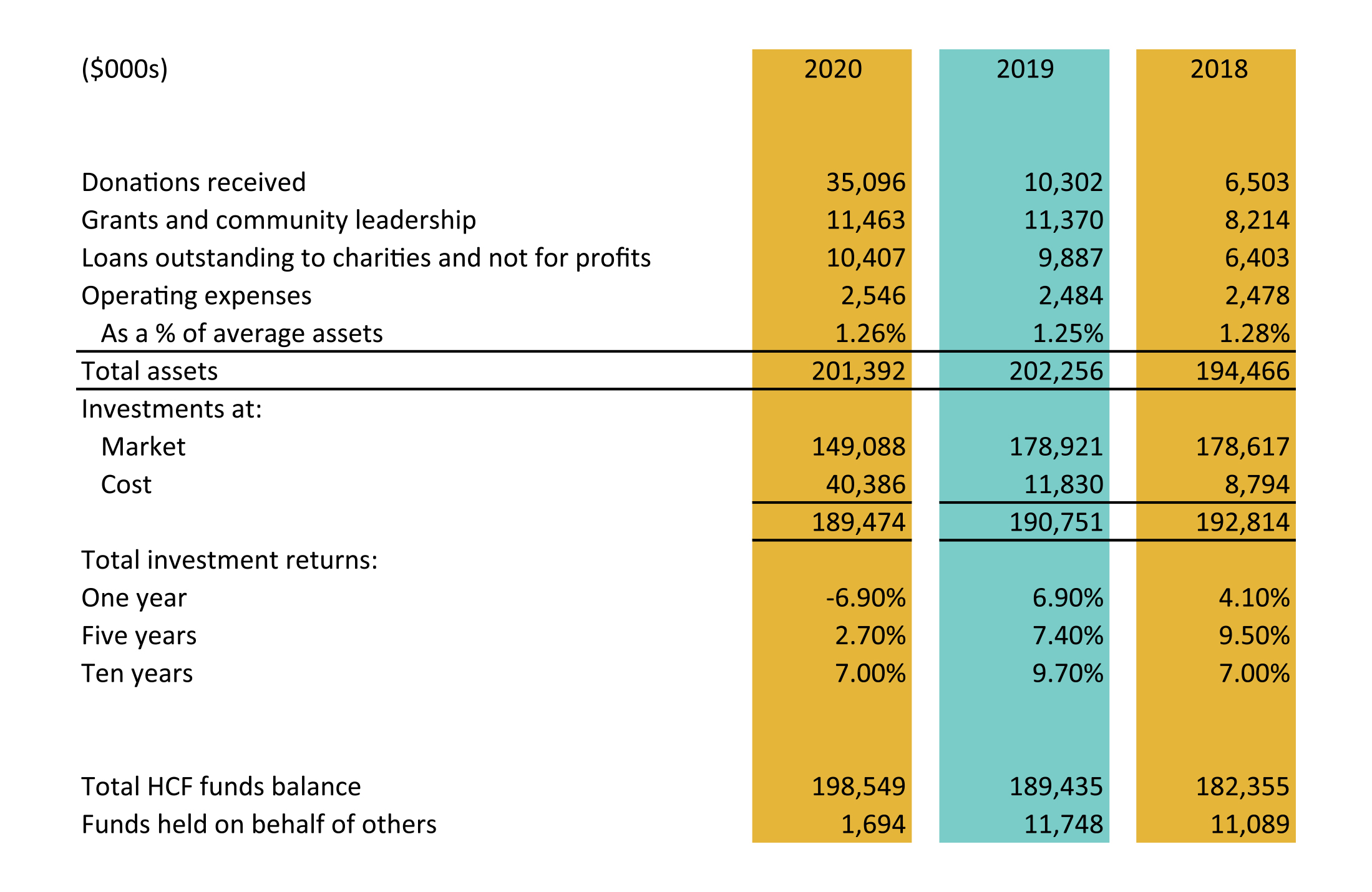
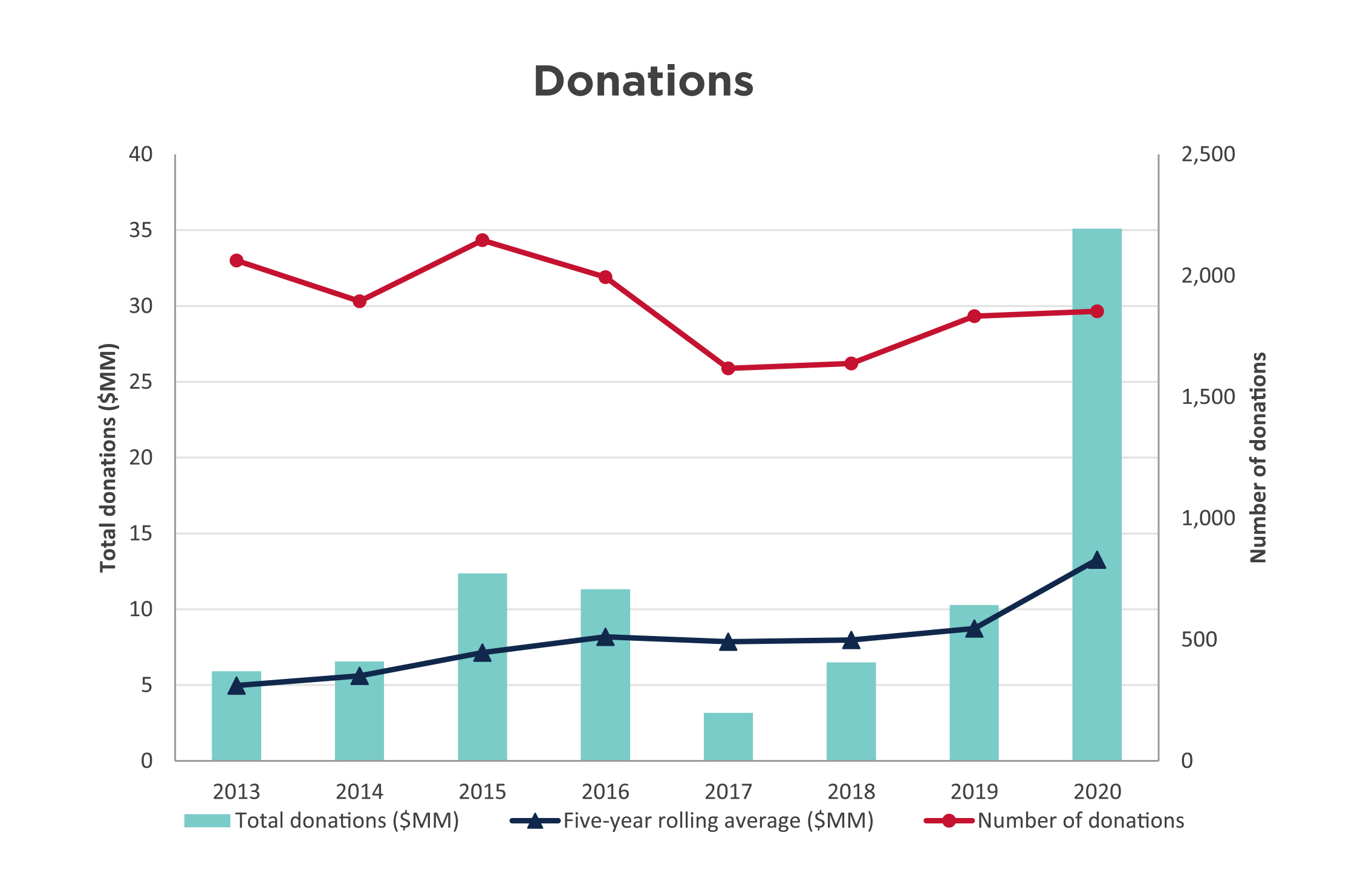
Donations to the Foundation are from individuals, corporations and other charities. Donors may contribute to named endowment or flowthrough funds, to the Board-directed Community Fund, or to HCF’s community leadership projects.
The $35.1 million in donations this year is the second highest total in HCF’s history. Annual donations are influenced by the timing of the realization of donations in wills and significant one-time donations like the $27.7 million in donations of property and private equity. As illustrated in Chart 1, annual donations have ranged between $3.2 and $35.1 million over the past eight years. The five-year rolling average of donations ranges from $5.0 million to $13.3 million over the past eight years.
The five-year rolling average number of donations is 1,787 with 2019-20 at 1,853. The number of donations fluctuates based on “in memoriam” donations and the number and nature of events sponsored by donors to raise money for their funds.
Chart 1
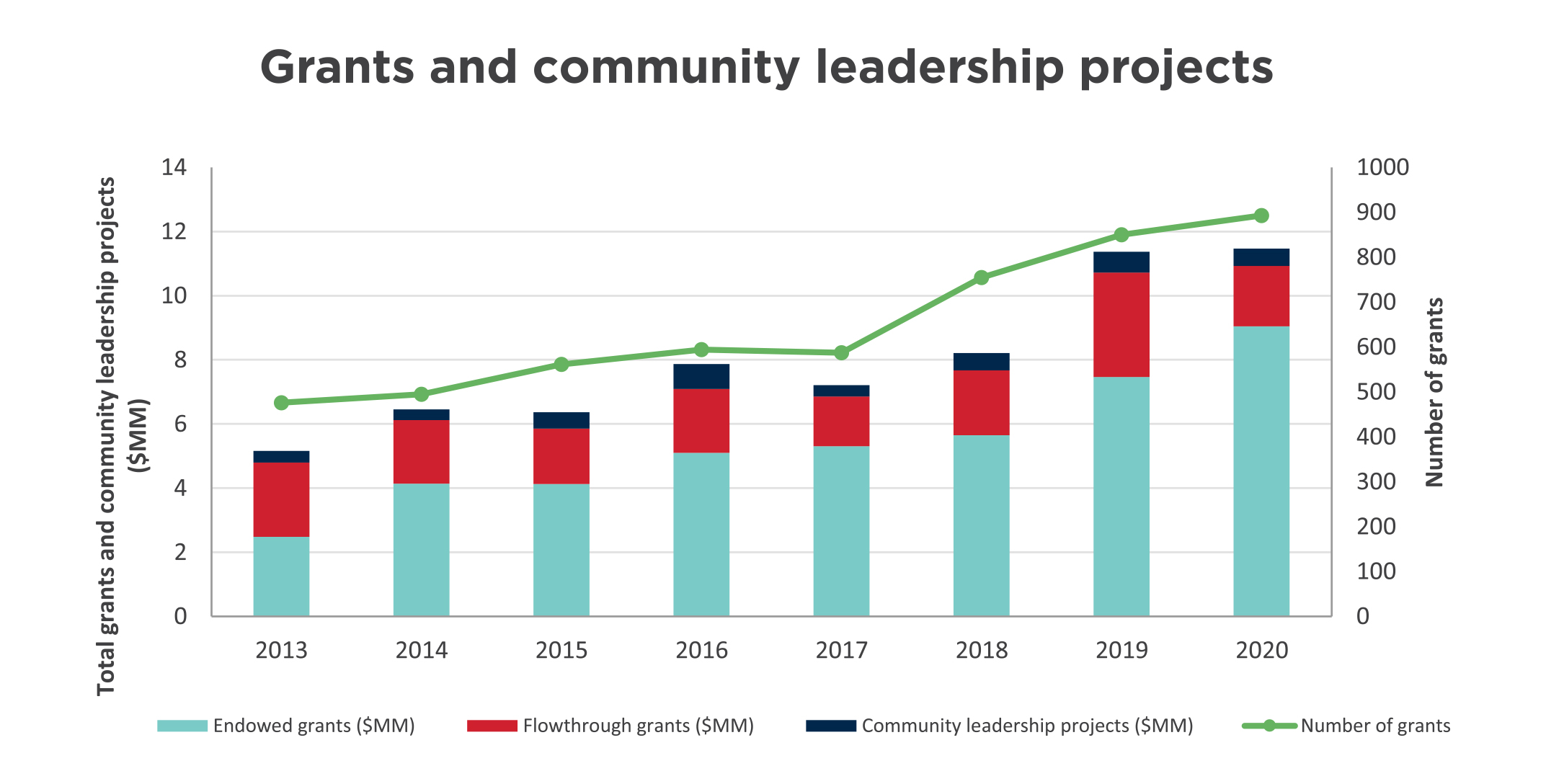
Grants are made annually from both endowed and flowthrough funds. Because flowthrough fund balances are distributed in a shorter time period, granting from these funds can materially influence HCF’s total annual amount granted.
As illustrated in Chart 2, grants and community leadership project spending over the past eight years has ranged from $4.7 million to this year’s historic high of $11.5 million. Granting from endowment funds was reduced in 2013 as a result of the decline in investment returns in 2012 which a) lowered the asset base used for the granting calculation (currently four percent of the fund balances), and b) resulted in less income available to grant. Flowthrough granting and expenditures on community leadership projects has ranged from 22 to 56 percent of total granting in any given year and is dependent on the timing and nature of flowthrough and project activity. At 893, the number of grants for this year is 37 percent higher than the eight-year average.
Chart 2
Investments traded in active markets are reported at fair market value. Investments not actively traded are recorded at their cost less any impairment of their value.
To support our strategy of aligning our assets with our mission and to provide a more diverse and robust portfolio, HCF has committed to investing in alternative asset classes including loans to charities and not-for-profits, private debt, real estate, infrastructure and private equity. These alternatives are consistent with the Foundation’s long-term investment horizon and liquidity requirements. Since these investments are not actively traded, they are valued at cost in the investments. These alternatives total $25.8 million.
HCF invests according to policy guidelines established by the Board of Directors. Two committees of the Board oversee investments to ensure compliance with the policy:
As an endowment builder, HCF’s policy focuses on long-term investing and is supported by reserve accounts that are currently at their policy maximum.
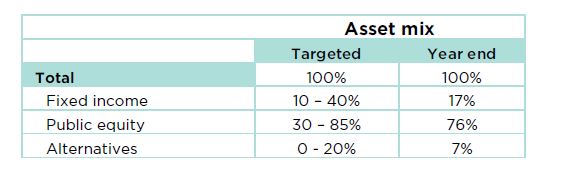
The investment policy sets out a total portfolio target asset mix, as well as a range around these targets. The public market investment managers have mandates within this targeted asset mix and use their discretion to invest the portfolios within this range. Chart 3 reflects the current and target asset mix. Note: $25 million of private equity relates to a fund established by a donor and is not part of the asset mix or the consolidated portfolio results.
Chart 3
Two long-term portfolios are invested in the public markets with Jarislowsky Fraser, and Connor, Clark & Lunn. Chart 4 compares those portfolios against benchmarks as follows:
Benchmarks reflect the performance of each market index based on HCF’s specific target asset mix. Comparing actual results to the benchmark measures the value added by investment managers compared to the average market performance. HCF’s investment policy target is a long-term investment return in the 6.5 to 7.5 percent range.
Chart 4
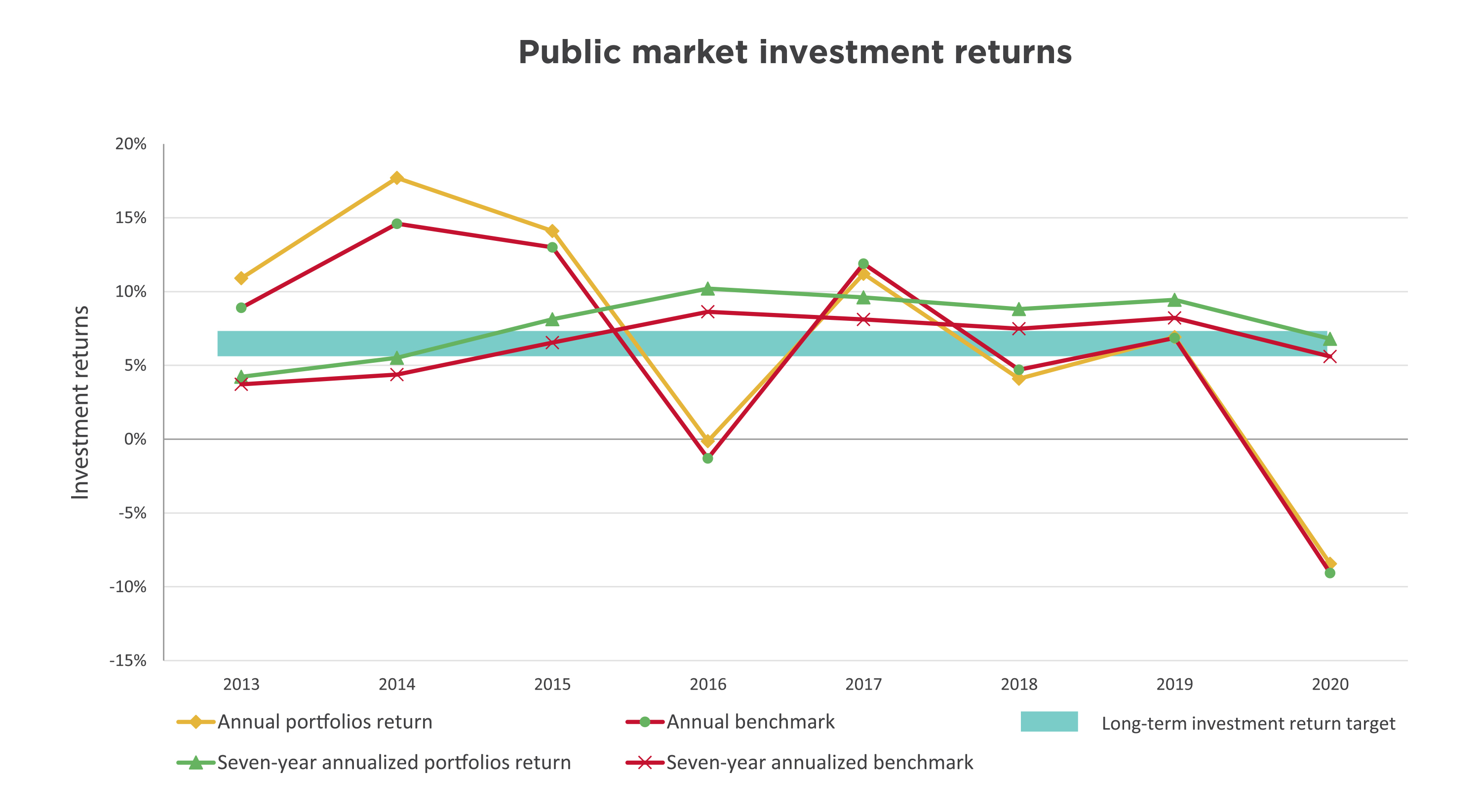
The effect of the global pandemic has materially affected investment returns, resulting in a -8.4 percent public market return for the year. The seven-year annualized return at 6.8 percent is within the targeted investment policy range and is 1.2 percent higher than the 5.6 percent benchmark. As noted in the financial highlights, the current 10-year annualized return of 7.0 percent is in the target range and is higher than the benchmark by 1.2 percent.
Impact investments enable donations to endowed funds to drive positive change beyond granting, because they represent investments of capital that deliver financial returns coupled with positive social and/or environmental outcomes. In addition, these investments provide a pool uncorrelated to the public markets which, in turn, buffers the portfolio from the volatility currently experienced.
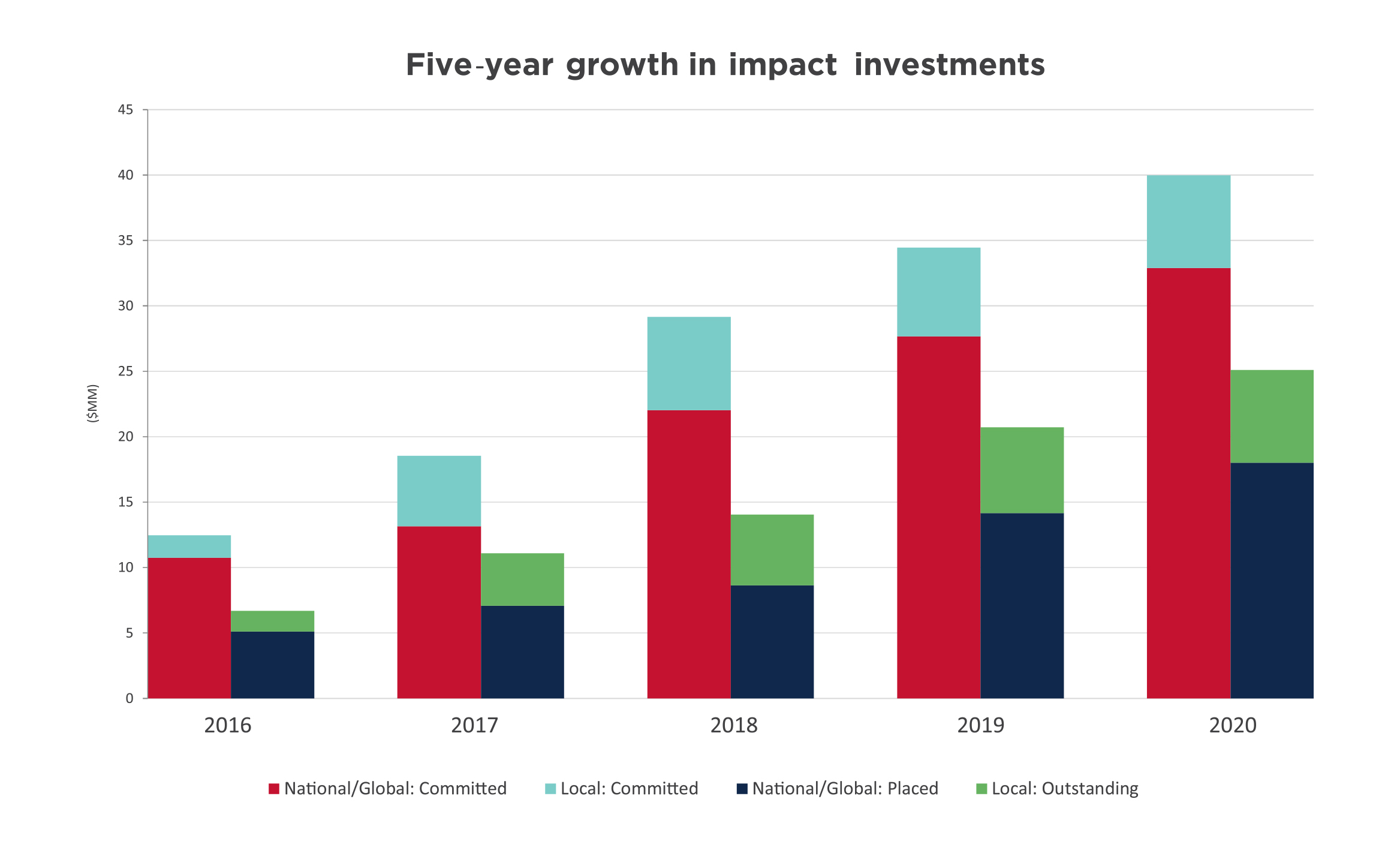
More than 15 percent of our long-term assets are in impact investments. Chart 5 illustrates HCF’s impact investing progress over the past five years, with $25 million currently placed or outstanding and another $15 million committed. This brings the total commitment to $40 million, up from $34 million last year. Impact investments cover areas including affordable housing, arts, environment and sustainable development.
Chart 5
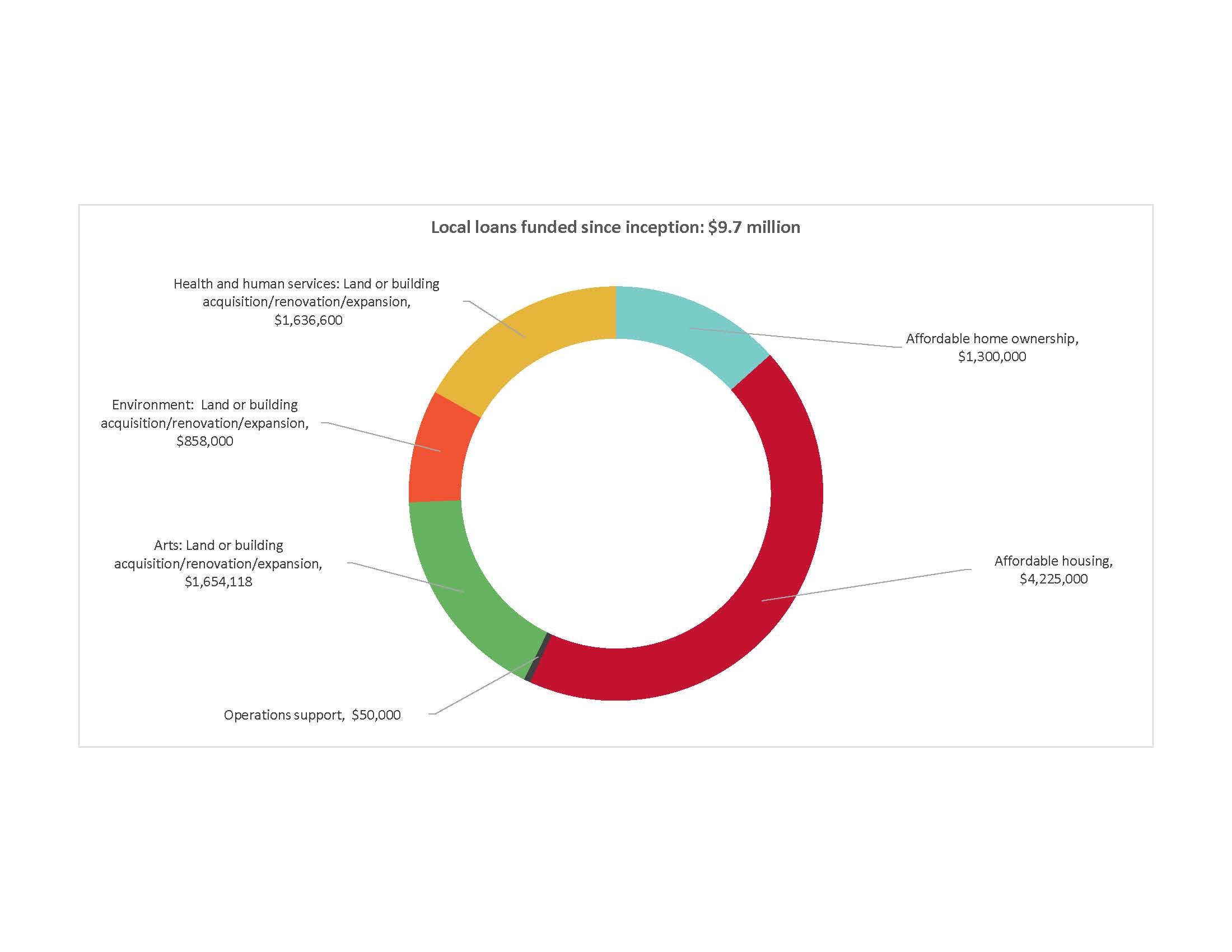
Local loans since inception total $9.7 million with $7.1 million outstanding at year end. Chart 6 shows the impact areas our loans have supported. Since the loan program’s 2012 inception, $2.6 million in loan principal has been repaid and recycled as new loans. In addition, the interest from these loans supports HCF granting.
Chart 6
IRP is a Government of Canada program being delivered nationally by partners including Community Foundations of Canada. As the first phase in the government’s long-term investment in social finance, the IRP’s goal is to make social-purpose organizations “investment ready” so they can make a difference in new and innovative ways through their participation in the social finance market. HCF has partnered with community foundations in London and Niagara, and the McMaster Innovation Park to manage the program regionally on behalf of Community Foundations of Canada. The first request for proposals for funding in January created enormous interest nationally and garnered 65 submissions to our regional partnership. Approved funding is expected to be released in June 2020. As an additional benefit, the IRP brought a growing number of potential opportunities for local loans to HCF’s attention.
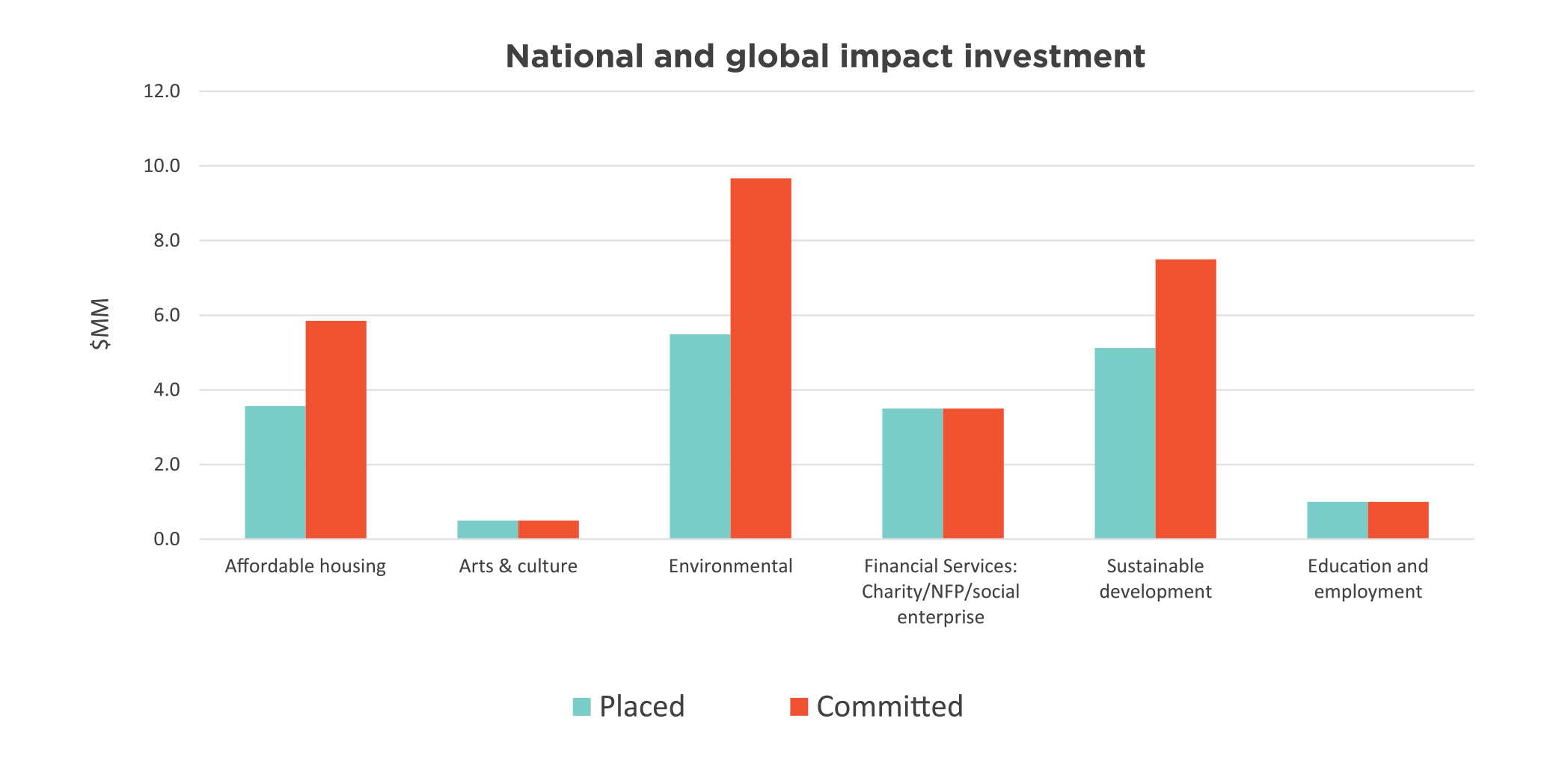
These investments include private equity, private debt and real estate investments. Many of these investments are long term in nature, are maintained at cost and do not have a regular income stream. As these investments are maintained at cost, their results include interest income and realized gains, but not unrealized gains. Results for these investments are closely monitored and are reported when realized. Chart 7 identifies the investment areas, with $18.0 million placed and a total commitment of $33 million across 21 investments.
Chart 7
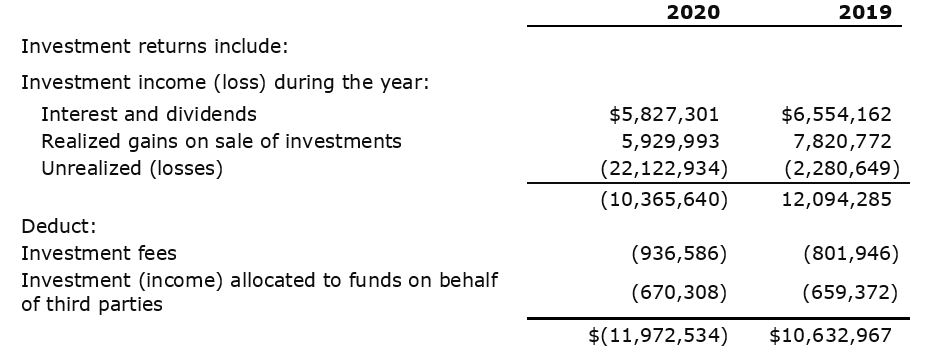
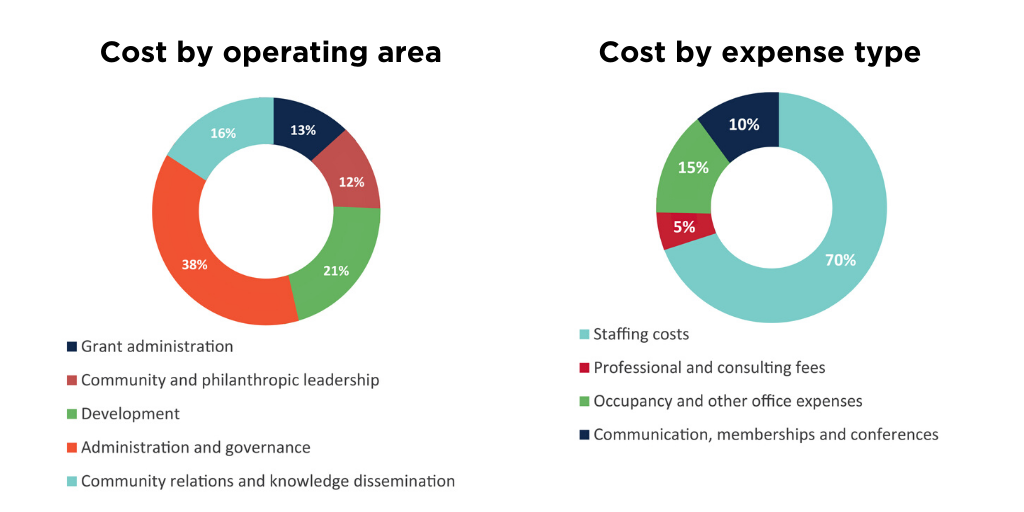
Operating expenses for the fiscal year ended March 31, 2020 total $2.5 million and were 2.5 percent higher than last year. Staffing costs related to the Foundation’s 22 employees represent 70 percent of HCF operating costs.
In addition to breaking out cost by type, operating costs are allocated to each of the Foundation’s operating areas: grants administration, community and philanthropic leadership, community relations and knowledge dissemination, development activities, and administration and governance. Examples of community and philanthropic leadership include convening around the city’s critical issues and fostering the growth of philanthropy by sharing staff time and knowledge to support other charities. Charts 8 and 9 illustrate these costs by operating area and by expense type.
Charts 8 and 9
The Foundation’s annual development expenses are not necessarily attributable to the donations received in that year. The nature of donations to the Foundation can result in costs preceding the receipt of the donation by several years (for example, donations through wills). As a result, consistent with the community foundation sector, operating costs are evaluated by a ratio of total operating expenses to average total assets. Ratios fall within a range depending on the size and stage of the community foundation’s development.
Management considers the ratio of 1.26 percent (1.25 percent in 2019), as illustrated in Chart 10, to be within an acceptable range for a foundation of HCF’s size, stage and level of community leadership, compared against benchmarks established in the community foundation sector. We continue to monitor both the actual results and the benchmarks on an ongoing basis.
Chart 10

Hamilton Community Foundation’s total assets of $201 million at March 31, 2020 include balances of HCF funds and funds held on behalf of others at $1.7 million.
Hamilton Community Foundation’s fund balances, illustrated in Chart 11, represent accumulated donations plus the net investment earnings on these donations, minus granting and operating costs. Funds include both endowed and flowthrough funds. Endowed funds are held permanently and grant from investment earnings. Flowthrough funds are fully distributed as grants over a pre-determined term.
Chart 11
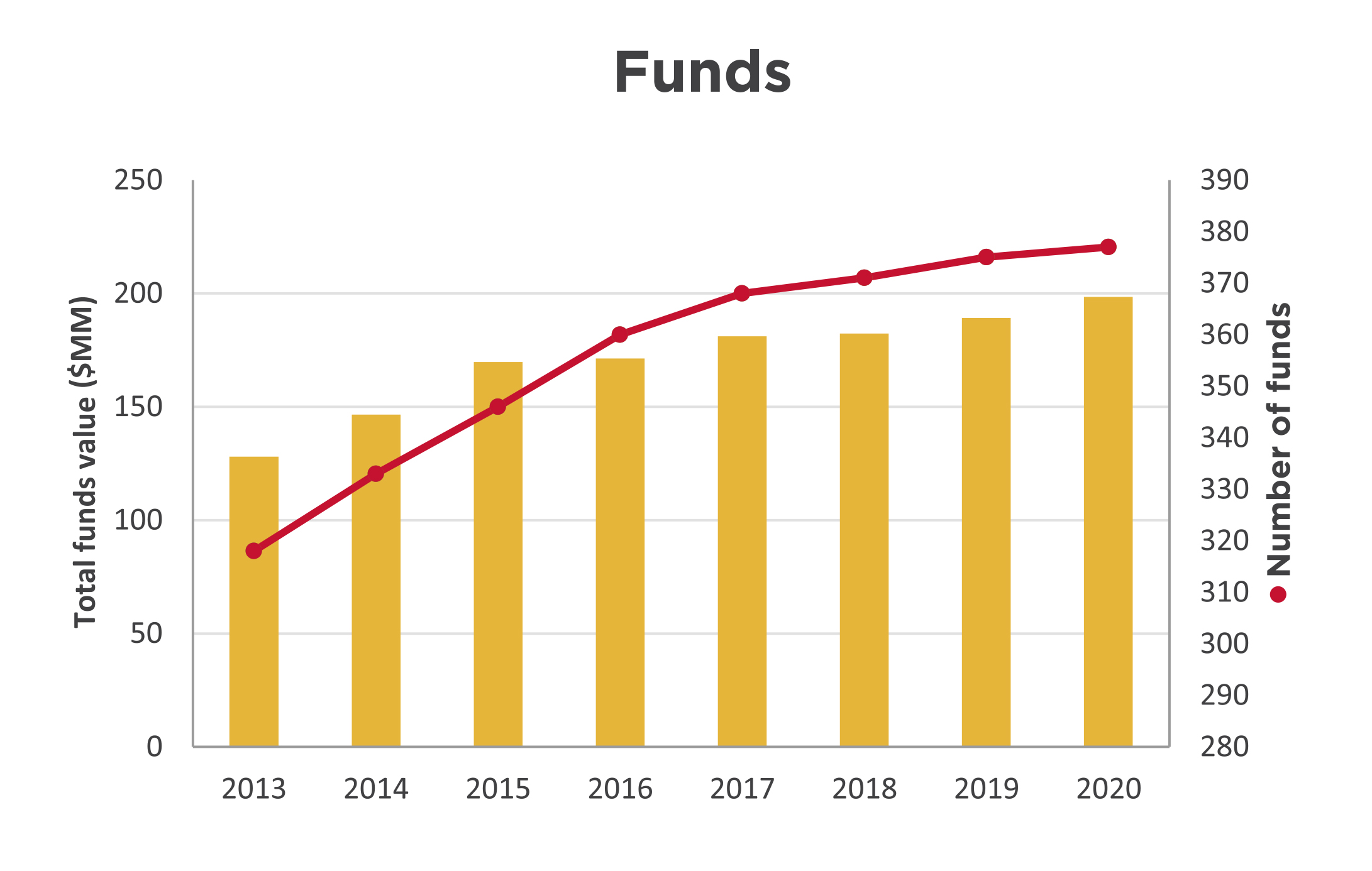
The fund balances have grown 55 percent to $198 million at the year ended March 31, 2020 from $128 million in 2013. Donations of $35.1 million included $4.4 million in flowthrough donations that were largely distributed as grants in the year and, as a result, do not remain in the fund balances at year end. This results in a modest total funds balance growth of 4.8 per cent for the year. The number of funds has grown 19 percent to 377 from 318 in 2013.
 Donate Today
