Sacajawea Non-Profit Housing Inc.
A loan from HCF to Sacajawea Non-Profit Housing Inc. is enabling the organization to buy property where they will build 23 affordable rental apartment units for Aboriginal families. The project is located in an area well-served by transit, schools and services including grocery shopping, government services, parks and an Aboriginal Health Access Centre.
“The indigenous population in Hamilton is growing more quickly than the City’s overall population and the existing units run by Aboriginal providers are geared to families,” said Sacajawea Executive Director, Melanie McAulay. “While more affordable housing is needed for all family types, this building will help address an unmet housing need for singles, couples and small families.”
Sacajawea is a non-profit organization that builds and maintains housing for low- to moderate-income Aboriginal families. With this new building development project, Sacajawea will address a critical gap for one-person and small-family Aboriginal households in Hamilton.
Neighbour to Neighbour Food Centre
Good healthy food is something that everyone should enjoy regardless of income. A new initiative by Neighbour-to-Neighbour is geared towards ensuring that low-income families on the Hamilton Mountain have dignified access to healthy meals. The “community food centre” – the seventh of its kind in Canada – is a welcoming community space that offers a range of programs with healthy food at its core.
Last year Neighbour-to-Neighbour was chosen from among 24 Ontario towns and cities to partner with Community Food Centres of Canada to open a centre. The location at Limeridge Road West is well-placed — Neighbour-to-Neighbour cites some 35 percent of residents in some Mountain neighbourhoods live below the poverty line. A new loan from HCF will help to finance renovations to the facility before it opens as the community food centre.
Although addressing food insecurity is at the heart of this initiative, the community food centre is distinct from a food bank because it involves more than just access to food. It also offers programs for skills development and education around healthy eating. Indeed, the benefits of community food centres are wide-ranging and include improvements in both physical and mental health.
Trillium Housing Inc.
Housing affordability can make a world of difference for families. That’s where Trillium Housing comes in. Trillium is a non-profit organization that creates housing affordability through financing and developing entry-level homes. The Trillium team itself has significant expertise with a combined 100 years of experience in real estate, construction and housing innovation.
A recently approved loan from HCF will allow Trillium Housing to develop a new site with 66 affordable townhouses for families with annual incomes as low as $45,000, an income level below the local median. This new build site represents Trillium Housing’s second Hamilton project with financing from the Hamilton Community Investment Fund.
Of significance to eligible families is the Trillium Mortgage which combines with conventional financing to provide housing affordability, and is payment-free until resale or discharge. Moreover, the value of the mortgage is based on the individual circumstances of income-eligible buyers. This structure provides a simple yet effective way to offer housing affordability to families with eligible income levels.
HCF regularly supports organizations and initiatives that deal with poverty, health and the environment. But it’s not every day that a project comes along that addresses all three at once, while also helping to unlock a lot more funding.
SoBi Hamilton, the popular bike sharing program, was launched with great success in 2015, but limited resources also limited the number of locations it could serve. Now, a grant from HCF’s Losani Family Foundation Fund and the Environmental Endowment Fund is helping to expand SoBi’s reach into neighbourhoods where more low-income residents can access the service.
Peter Topalovic, Hamilton Bike Share & Smart Commute program manager with the City of Hamilton says HCF’s support to the pilot project, known as Everyone Rides, has also been the key to garnering a matching grant of $275,000 from the Federation of Canadian Municipalities (FCM).
“The community foundation was more than a partner in this initiative,” says Peter. “Not only did its contribution allow SoBi to access the full match from FCM, the Foundation team was also very supportive in bringing their knowledge to maximize community benefit. They really understood the initiative and the importance of having accessible transportation throughout the city.”
Through Everyone Rides, Hamilton will become a frontrunner in North America in bike share systems to serve low-income neighbourhoods. The program also includes supports such as cycling safety and skills training to overcome barriers to bike use experienced in other cities.
By encouraging more people to ride bikes, SoBi creates sustainable transportation from which the only energy burned is calories.
From Summer 2016 Legacy newsletter
A remarkable donation to Hamilton Community Foundation will help ensure local cats will be healthy, safe and wanted – forever.
The Foundation will give an annual grant of over $65,000 in perpetuity to the Hamilton/Burlington SPCA to fund feline health and well-being, thanks to the donation of an estate from lifelong pet lover and long-time Hamilton cab owner, George Seliga.
“Pets provide companionship and are important family members for so many people,” says Terry Cooke, Hamilton Community Foundation president & CEO. “We are thrilled to have helped Mr. Seliga create the legacy he wanted.” Cooke says that because the donor wanted to do something that would benefit animals forever, he established an endowed fund, meaning that the donation is invested, generating the income that will be granted to the HBSPCA every year.
“It’s just one wonderful example of the many donors who have entrusted the Foundation to help them support those things that have had meaning to them during their lives – even when their own lives are over.”
Founded in 1887, the Hamilton SPCA (“HBSPCA”) was established to protect vulnerable animals. Today, the HBSPCA protects animals at risk, cares for and rehomes neglected and homeless pet companions, and promotes respect for all animals. Donors support affordable spay/neuter programs for family-owned pets and pets belonging to persons-at-risk. Donors and local veterinarians together support spay/neuter for free-roaming cats.
“Every spring, our kennels and foster homes are filled with homeless and neglected cats and kittens,” says HBSPCA CEO Marion Emo. “Mr. Seliga’s generous donation will help us to expand quality programs that support the three essential things that pet parents can do for their animal’s well-being: spay or neuter them, give them regular, preventative veterinary care, and have them micro-chipped for a safe return home if lost.” Emo says that the grant will make services to rescue groups and low-income families more accessible. “Combined with education about responsible cat care, we are confident that abandoned cat populations will significantly decrease and every cat will be a wanted cat.
Michael Young always wanted to work as a security guard. Good Shepherd’s MarketPlace work experience program helped him get there.
The MarketPlace is part of Good Shepherd’s Venture Centre, a massive repurposed car dealership in downtown Hamilton that opened as the organization’s clothing and emergency food program in 2015 and served 69,000 people in its first year.
“It’s like a small Fortinos,” says Carmen Salciccioli, director of the Good Shepherd Centre. “There is selection and dignity. We’re a one-stop shop for everything.”
Everything, it turns out, including a job.
An HCF grant is supporting the work experience program, which builds skills to help participants be job-ready. They are interviewed, receive training, follow a work plan that they help create, get regular feedback and receive a reference letter on successful completion. The program is expected to assist 30 people during its first year, increasing to 80 annually by year three.
“It makes total sense to do pre-employment training here,” says Carmen. “Our MarketPlace program evaluation showed that the number one reason people access our services is insufficient income.”
Program participants stock shelves, work the cash, work in the warehouse and perform janitorial tasks—all skills they can transfer to a number of industries. Soon job experiences will expand to include landscaping, painting, pest control and more.
Michael is proof that the model works. He started at the MarketPlace last June and today is working in the job he wanted. “Volunteering at the MarketPlace was something I could add to my resume,” he says. “It showed my employer that I’m focused and dedicated to working and made me feel more confident.”
“With this program, everyone has some skin in the game,” Carmen says. “We do it together, not us on their behalf. The only thing holding us back is our imagination.”
Excerpt from 2016 Annual Report
Ten Grade 6, 7 and 8 students are spending their nutrition break learning how to make a video game—and at the same time learning they could have a bright future in technology. 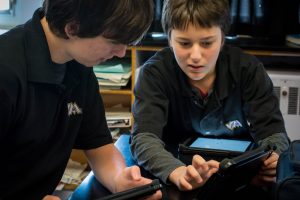
The club at Viscount Montgomery Elementary School is one of 17 currently offered to middle school-aged students in Hamilton’s public and Catholic schools. Three years of ABACUS funding from Hamilton Community Foundation is turning the clubs from a successful but resource-strapped pilot into a stable, sustainable program run through the Industry Education Council. “Without HCF’s support we couldn’t structure the program or follow up,” says co-ordinator, Beth Gibson. “Now we have the resources to grow.”
Canada has a shortage of 182,000 information and communication technology (ICT) workers. Kevin Browne, founder of Software Hamilton and a Code Club champion, sees hundreds of local ICT jobs go to out-of-town talent because no one from Hamilton applies. “We have a pipeline problem,” he says. “If students aren’t introduced to technology in middle school they won’t take it in high school and it might as well be rocket science.”
The weekly program targets schools in Hamilton’s Neighbourhood Action Strategy but any school is welcome, particularly if it encourages girls to join (only 24 percent of ICT workers in Canada are women). Weekend clubs and summer camps are planned for the Central Library. The clubs are facilitated by post-secondary students and ICT entrepreneurs. A McMaster University study will determine the program’s impact on the post-secondary perceptions of students.
It’s only week two at the Viscount Montgomery club, but already every iPad is running a rudimentary video game that the students have programmed themselves. “It’s so exciting to see their interest growing,” says teacher Sarah Weston. “Lightbulbs are going off. They’re realizing it could be a career for them.”
“I want to see a Code Club in every school in Hamilton,” says Kevin. “Of all the things that are happening in tech in the city right now, I think this is the most important.”
Excerpt from 2016 Annual Report
Establishing a long-term endowment fund at Hamilton Community Foundation has given the Canadian Warplane Heritage Museum “instant credibility” with contributors says the museum’s President and CEO, David Rohrer. 
“We needed to develop a legacy gifts program for the museum,” he says, “and we quickly realized that we weren’t best suited internally to manage those investments. The community foundation offers the expertise we need. We are very pleased to be affiliated with HCF in this way. It was the right step.”
David points out that placing its endowment with HCF – the organization made its initial investment in 2015 – also exposes the museum to a wider range of potential supporters. The museum has a goal of contributing 10 percent of undesignated gifts to the fund, he says, and having the endowment at arm’s length protects it from the pressures of day-to-day operations.
“We are community-based and proud to be in Hamilton,” says David, “and we are very grateful for HCF’s support of the museum’s High Flight program, in addition to the endowment fund.” The High Flight initiative offers field trips and approved curriculum to Grade 6 science and Grade 10 history students. Twenty-five schools in the region participated this year. David illustrates the influence of the program: one of Canada’s current CF-18 fighter pilots reports that he got his first taste of aviation with a visit to the museum decades ago.
“The Canadian Warplane Heritage Museum is the largest flying museum in Canada,” says Terry Cooke of HCF. “It has been a Hamilton treasure for 44 years. We are thrilled that such an outstanding organization trusts us to manage its long-term endowment.”
Excerpt from 2016 Annual Report

Marnie and Bill Brehm
Marnie Brehm has been involved with Hamilton Community Foundation since the 1980s, as a Board member and a contributor. She knows it well and trusts it to understand community needs. She and her husband Bill contribute regularly to the Community Fund.
“The Community Fund gives the Foundation capacity to respond to the most urgent needs in the community,” she says. Recent examples include the Foundation’s poverty work and its ABACUS education initiative.
Marnie, an accountant, and Bill, a retired planning consultant, have volunteered their time and talents at the leadership level in many organizations over the decades and they have confidence that Hamilton Community Foundation assesses community needs effectively. That is one reason they support the Community Fund – what Bill says in other organizations might be called the “general fund.” They also like the flexibility the Community Fund gives the Foundation and the speed with which it responds to changing community needs.
Marnie and Bill both support the community in a variety of ways – through HCF and other organizations – and they feel giving to the Community Fund is an important component of their philanthropy.
“While we could choose to support a particular cause or issue – and we do that in other aspects of our giving – we think the Community Fund is crucial too,” Marnie says. “The Foundation is in a position to best determine the needs of the community and this gives them the capacity to respond.”
Bill agrees: “Marnie’s Board experience and our contacts with staff give us confidence in the Community Fund decision-making process. The Foundation works hard to identify and address key needs to be filled in the community.”
Excerpt from 2016 Annual Report

Buying property, they say, is all about location—especially when it comes to the purchase of two critical pieces of land in the Dundas Valley, made possible by Hamilton Community Foundation.
The properties sit in the Cootes to Escarpment EcoPark System, an ongoing initiative to protect, connect and restore more than 9,600 acres of some of Canada’s most biologically diverse land. The two properties, both located in the Pleasant View area, now create a protected wildlife corridor stretching from marsh to Mountain.
“These two properties were the key to everything,” says Jen Baker, land securement coordinator for the EcoPark System. “We wanted them for years. Now there’s a permanent dark green link between Cootes and the escarpment.”
Both properties are nesting sites for endangered birds and home to wild plants. “They are significant both in terms of the role they play in the landscape and the habitat they provide,” Jen says.
The EcoPark System’s partner organizations had enough funds to buy one property and had been told the second would have a year-long closing, giving them time to raise the extra money. Suddenly the game changed: they would have to purchase both properties at once. That’s where HCF came in.
The Foundation stepped up with support on a number of fronts. A grant from the Frank Charles Miller Fund helped buy the first property, and the Heather and Ross Hamlin Fund not only provided a grant to help with the land purchase but is also offering another $150,000 to match funds raised from individuals in the community. The Foundation also provided a loan through its Hamilton Community Investment Fund.
“The whole deal would have fallen through without HCF,” Jen says. “We might have been able to go back to the table at some point, but it would have put the whole project in jeopardy for an indefinite period of time.”
“This project is not only exciting because of the land it protects,” says Annette Aquin, HCF’s Executive Vice-President of Finance and Operations. “It also uses HCF’s full complement of resources to drive positive change. When the loan is repaid the money will be directed to other important projects and the interest will be used for future granting. It’s really a win-win for Hamilton.”
Excerpt from 2016 Annual Report

The beads represent objects that relate to a student’s potential through education. Each abacus bead was sculpted on a computer and then 3D printed. Steve Mazza, Artist
Terry and Brenda Yates see the community foundation’s current emphasis on education as a “natural evolutionary step” from its focus on eliminating poverty and they’ve made a significant commitment to help launch ABACUS, HCF’s community-wide initiative.
“As a former teacher,” says Brenda, “I believe that education is one of the best ways to bring people out of poverty. If you can help keep children on an educational path, they will find their way – despite difficult challenges in their backgrounds.”
Terry points to the mentoring component of the ABACUS program as one of the critical factors. “If children see someone older succeeding because of education – an older brother or an uncle or someone else they know – it makes a huge difference. That’s what we’re trying to do.”
The Yates have been actively involved with Hamilton Community Foundation since the 1990s and they appreciate its role in the community. “It’s an incubator,” says Brenda, describing the Foundation’s process of researching issues, bringing stakeholders together, and crafting shared solutions that maximize every partner’s unique contribution. They were early champions of the ABACUS idea and look forward to seeing it adopted in different ways across the community. Their new fund at HCF – the Terry and Brenda Yates Fund – is targeted at ensuring that “all children and youth have access to educational opportunities.”
“HCF is playing a unique leadership role,” says Terry, about why HCF is the home of their new fund. “The quality and commitment of the personnel at the community foundation is respected in the city. It’s recognized as an organization that believes in the future.”
Both Brenda and Terry love Hamilton and marvel at how readily Hamiltonians participate in philanthropy – with time or resources, each according to what he or she can do. While they are two outstanding examples, whose impact is incalculable, Terry just says “if you have a chance to make a difference, you should take it.”
Excerpt from 2016 Annual Report

This work depicts words overlaid with distinct shapes — the right represents the hospital staff, lawyers and funding, while the left is the family. Of interest is the independence of both shapes — never quite taking over or overlapping, but instead respecting the space and the support needed. Stephanie Seagram, Artist
When your child is in the hospital, the last thing you want to hear is you’ve lost your job because you’ve spent too much time away from work.
Thanks to the medical-legal partnership started by Pro Bono Ontario (PBO) at McMaster Children’s Hospital, low-income families can get much-needed legal support when faced with such difficult circumstances. “These are families who are already doing so much,” says lawyer, Hilary Mack. “This service can take a little stress off their plate.”
Hilary’s title is “triage lawyer”—a nod to the hospital setting and a direct reference to her role as a resource for quick assessment and referral. “Like a doctor would look at a patient, I look at their legal issue and recommend how best to address it.”
Consultations often happen at the child’s bedside but an important part of the program is training clinicians to recognize the signs of legal concerns so they can refer families. The most common concerns Hilary sees relate to family law, immigration, government benefits, employment, education and housing. She refers more complex cases to the program’s partners Ross & McBride and Gowlings, who take the cases pro bono, and the Hamilton Community Legal Clinic.
PBO has established medical-legal partnerships in five children’s hospitals since 2009. The Hamilton program is a pilot supported by the Ruth Hindmarsh Atkinson Award. A grant from HCF’s Edith H. Turner Foundation Fund is expanding Hilary’s time onsite, which is critical to keeping the program top of mind for the clinicians who refer families to the services.
PBO executive director Lynn Burns says the program not only helps overwhelmed families focus on caring for their children, but the experience at Toronto SickKids shows other long-lasting benefits.
“Families may have multiple legal problems that have been unresolved for years,” she says. “In our SickKids evaluation, none of the families had sought legal assistance prior to the social worker suggesting they contact our program—and 89 percent said we improved their financial situation. It’s a good poverty reduction strategy.”
Excerpt from 2016 Annual Report
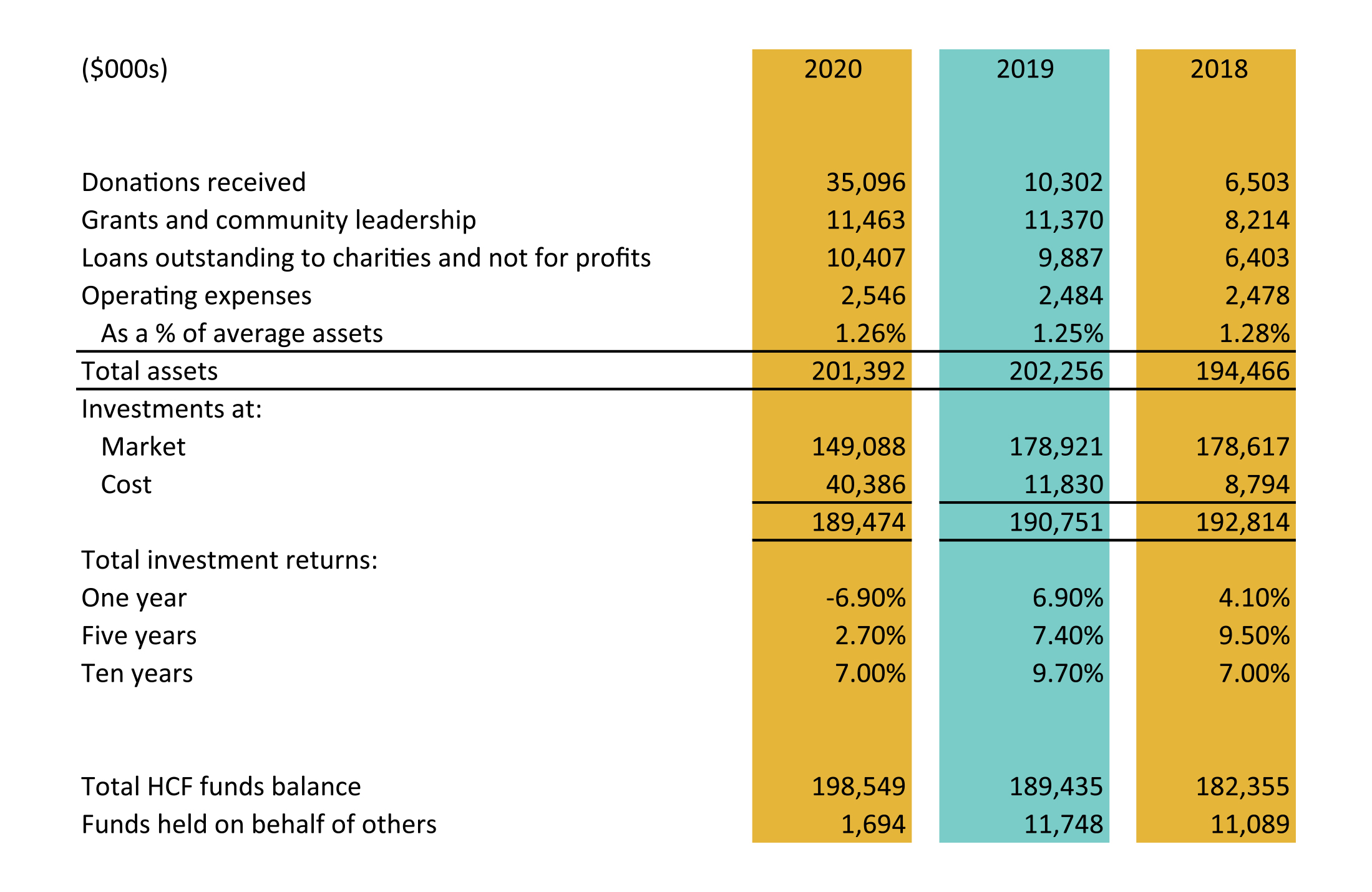
Donations to the Foundation are invested for the long term in public markets and in alternative investments. Investment income is then allocated annually to support granting, community leadership and operations. The summary and charts presented here provide both a financial snapshot and a history of recent activity that underlies the grants and community leadership activities represented in this annual report, made possible by remarkable donors.
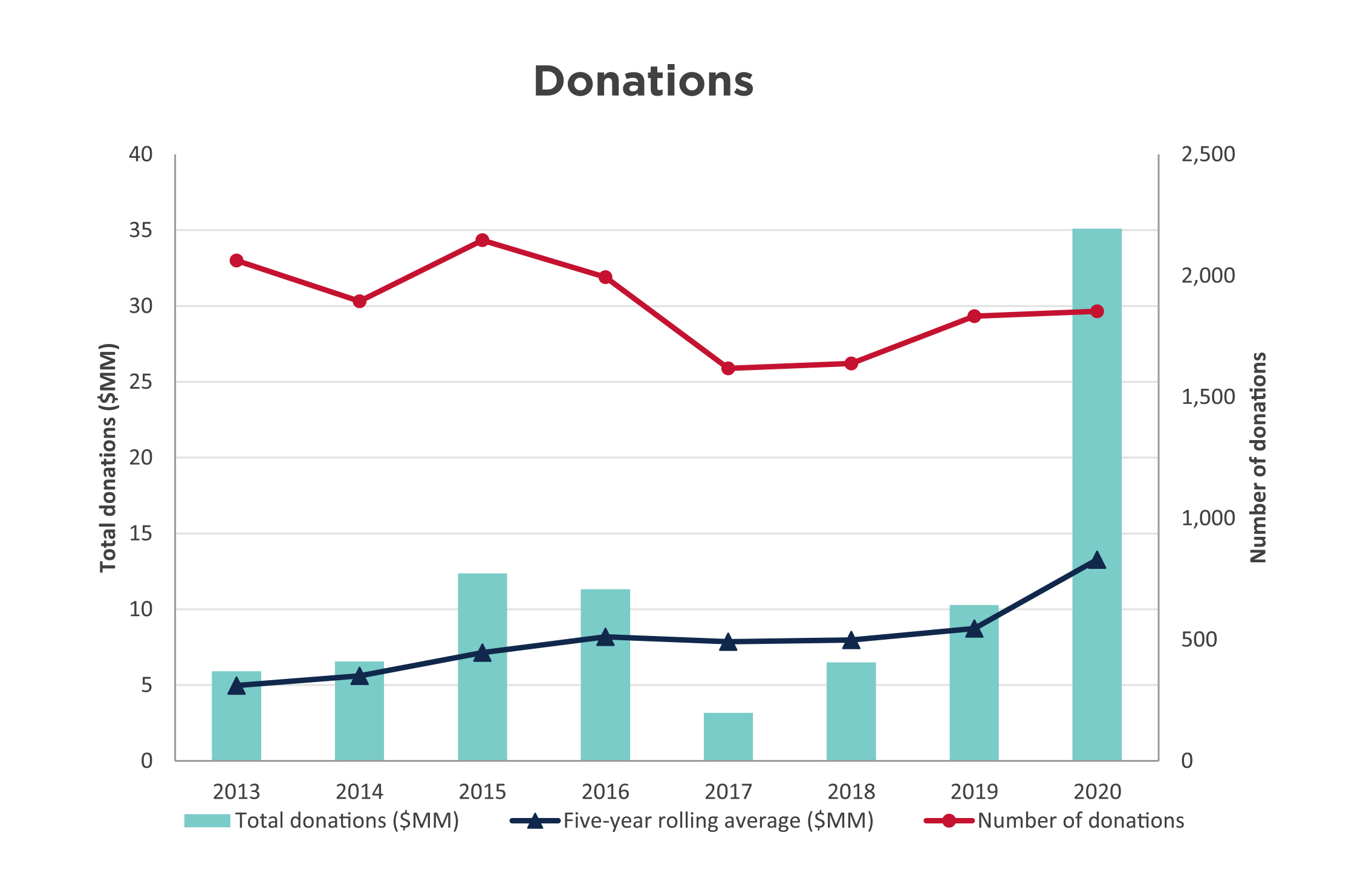
Donations to the Foundation are from individuals, corporations and other charities. Donors may contribute to named endowment or flowthrough funds, to the Board-directed Community Fund, or to HCF’s community leadership projects.
The $35.1 million in donations this year is the second highest total in HCF’s history. Annual donations are influenced by the timing of the realization of donations in wills and significant one-time donations like the $27.7 million in donations of property and private equity. As illustrated in Chart 1, annual donations have ranged between $3.2 and $35.1 million over the past eight years. The five-year rolling average of donations ranges from $5.0 million to $13.3 million over the past eight years.
The five-year rolling average number of donations is 1,787 with 2019-20 at 1,853. The number of donations fluctuates based on “in memoriam” donations and the number and nature of events sponsored by donors to raise money for their funds.
Chart 1
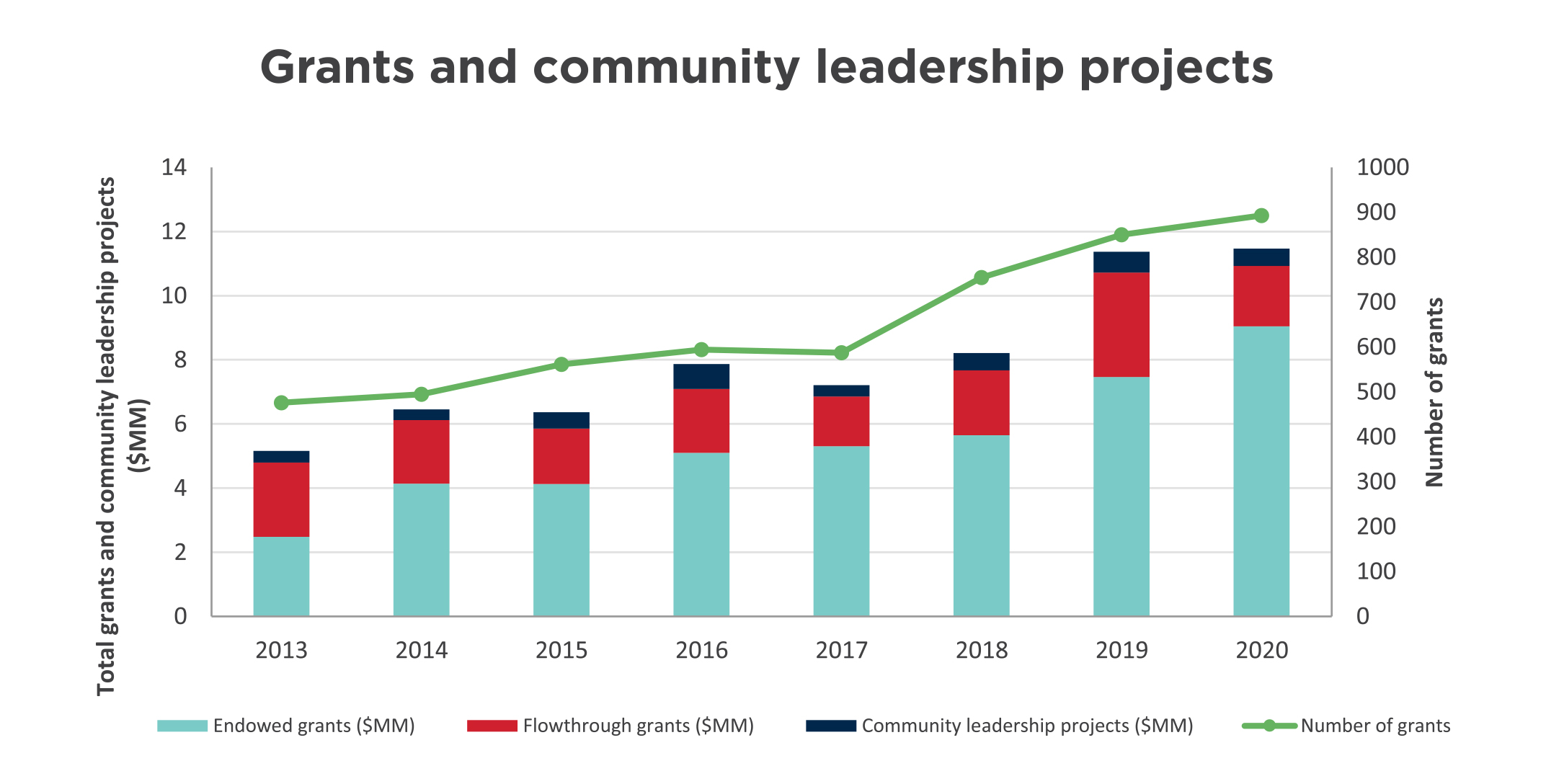
Grants are made annually from both endowed and flowthrough funds. Because flowthrough fund balances are distributed in a shorter time period, granting from these funds can materially influence HCF’s total annual amount granted.
As illustrated in Chart 2, grants and community leadership project spending over the past eight years has ranged from $4.7 million to this year’s historic high of $11.5 million. Granting from endowment funds was reduced in 2013 as a result of the decline in investment returns in 2012 which a) lowered the asset base used for the granting calculation (currently four percent of the fund balances), and b) resulted in less income available to grant. Flowthrough granting and expenditures on community leadership projects has ranged from 22 to 56 percent of total granting in any given year and is dependent on the timing and nature of flowthrough and project activity. At 893, the number of grants for this year is 37 percent higher than the eight-year average.
Chart 2
Investments traded in active markets are reported at fair market value. Investments not actively traded are recorded at their cost less any impairment of their value.
To support our strategy of aligning our assets with our mission and to provide a more diverse and robust portfolio, HCF has committed to investing in alternative asset classes including loans to charities and not-for-profits, private debt, real estate, infrastructure and private equity. These alternatives are consistent with the Foundation’s long-term investment horizon and liquidity requirements. Since these investments are not actively traded, they are valued at cost in the investments. These alternatives total $25.8 million.
HCF invests according to policy guidelines established by the Board of Directors. Two committees of the Board oversee investments to ensure compliance with the policy:
As an endowment builder, HCF’s policy focuses on long-term investing and is supported by reserve accounts that are currently at their policy maximum.
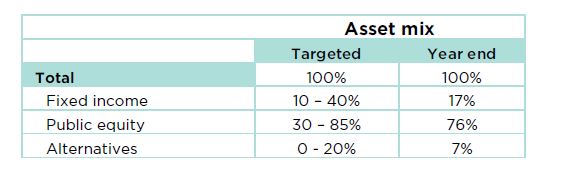
The investment policy sets out a total portfolio target asset mix, as well as a range around these targets. The public market investment managers have mandates within this targeted asset mix and use their discretion to invest the portfolios within this range. Chart 3 reflects the current and target asset mix. Note: $25 million of private equity relates to a fund established by a donor and is not part of the asset mix or the consolidated portfolio results.
Chart 3
Two long-term portfolios are invested in the public markets with Jarislowsky Fraser, and Connor, Clark & Lunn. Chart 4 compares those portfolios against benchmarks as follows:
Benchmarks reflect the performance of each market index based on HCF’s specific target asset mix. Comparing actual results to the benchmark measures the value added by investment managers compared to the average market performance. HCF’s investment policy target is a long-term investment return in the 6.5 to 7.5 percent range.
Chart 4
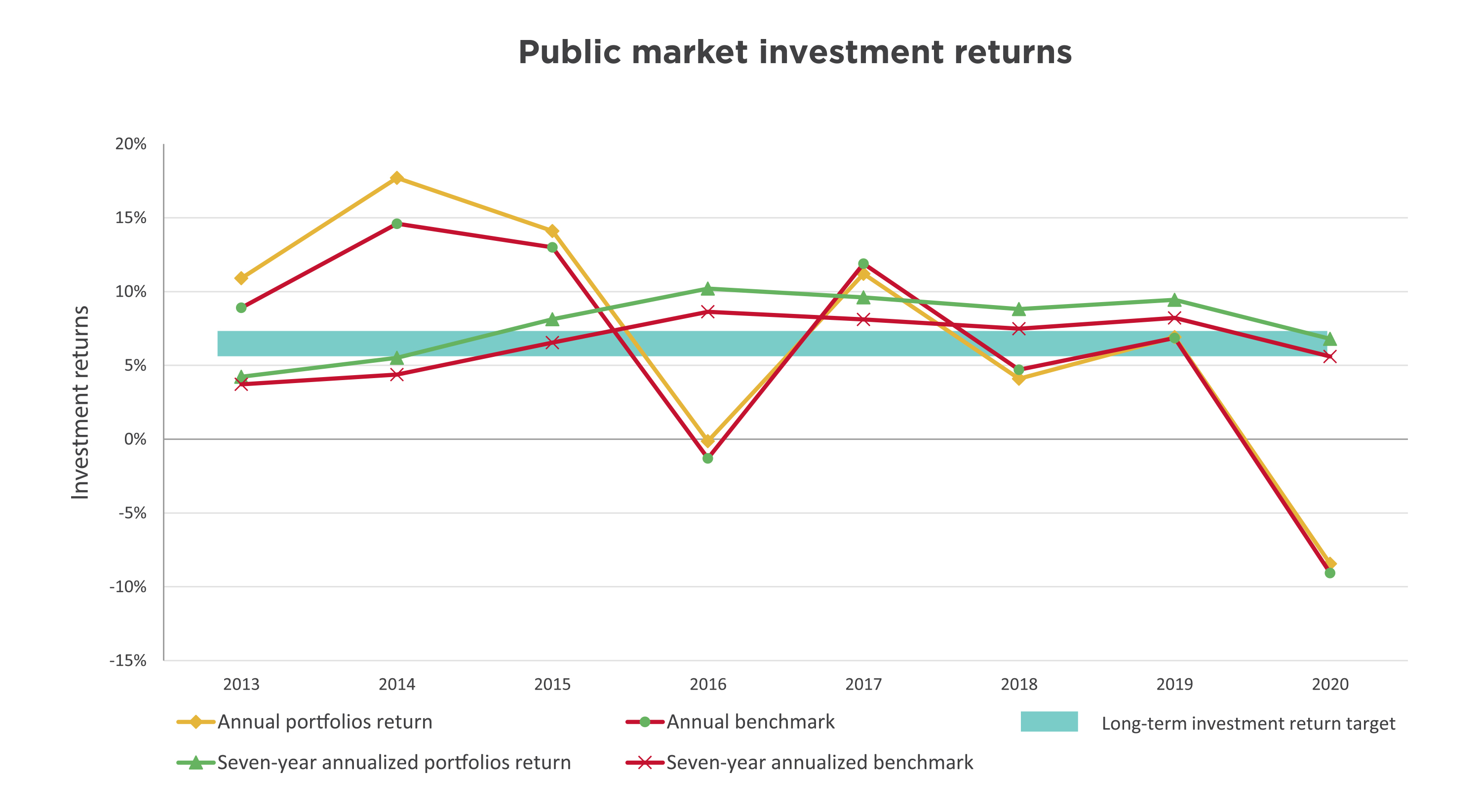
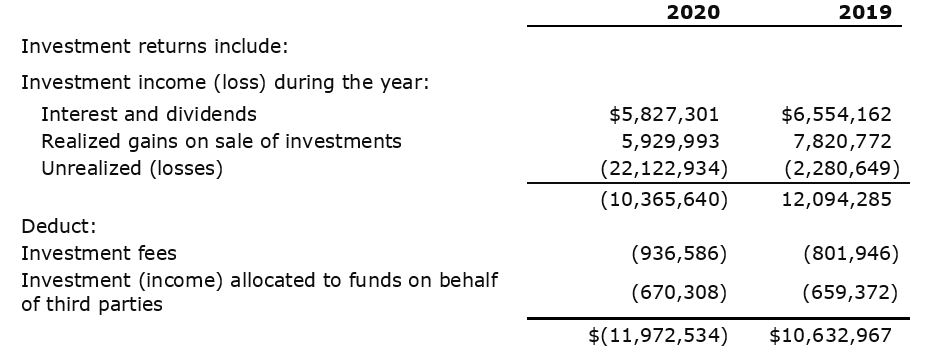
The effect of the global pandemic has materially affected investment returns, resulting in a -8.4 percent public market return for the year. The seven-year annualized return at 6.8 percent is within the targeted investment policy range and is 1.2 percent higher than the 5.6 percent benchmark. As noted in the financial highlights, the current 10-year annualized return of 7.0 percent is in the target range and is higher than the benchmark by 1.2 percent.
Impact investments enable donations to endowed funds to drive positive change beyond granting, because they represent investments of capital that deliver financial returns coupled with positive social and/or environmental outcomes. In addition, these investments provide a pool uncorrelated to the public markets which, in turn, buffers the portfolio from the volatility currently experienced.
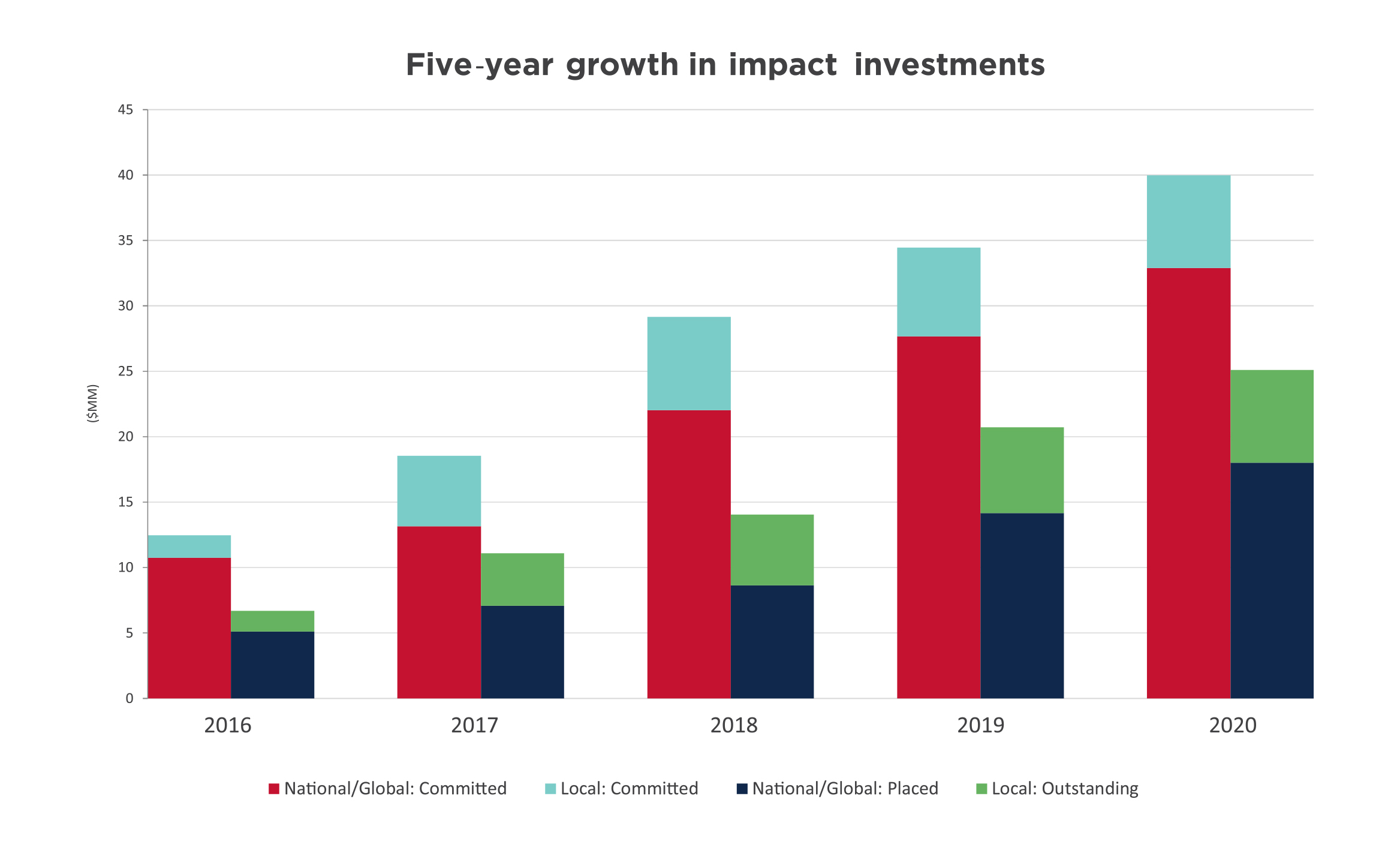
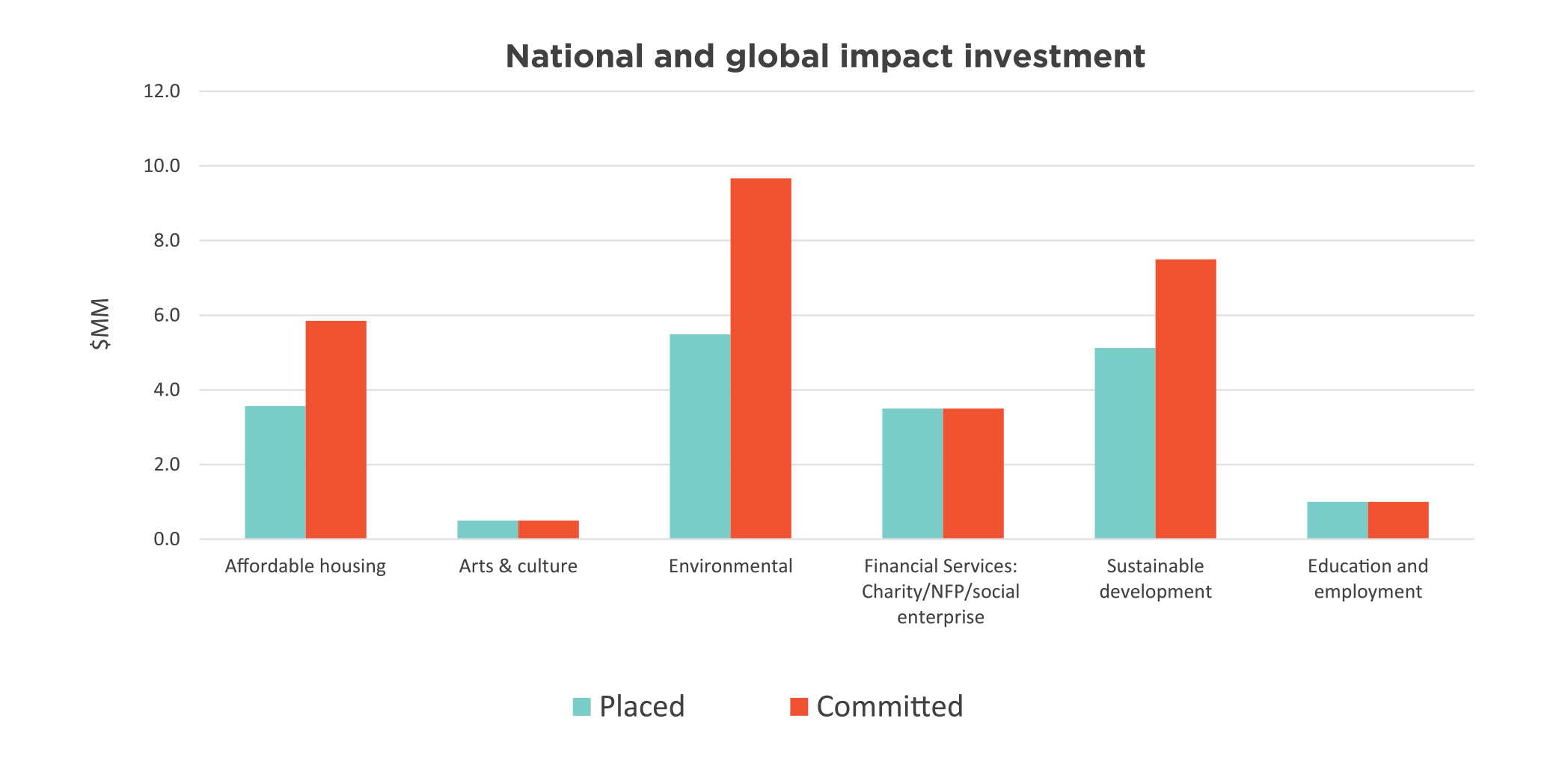
More than 15 percent of our long-term assets are in impact investments. Chart 5 illustrates HCF’s impact investing progress over the past five years, with $25 million currently placed or outstanding and another $15 million committed. This brings the total commitment to $40 million, up from $34 million last year. Impact investments cover areas including affordable housing, arts, environment and sustainable development.
Chart 5
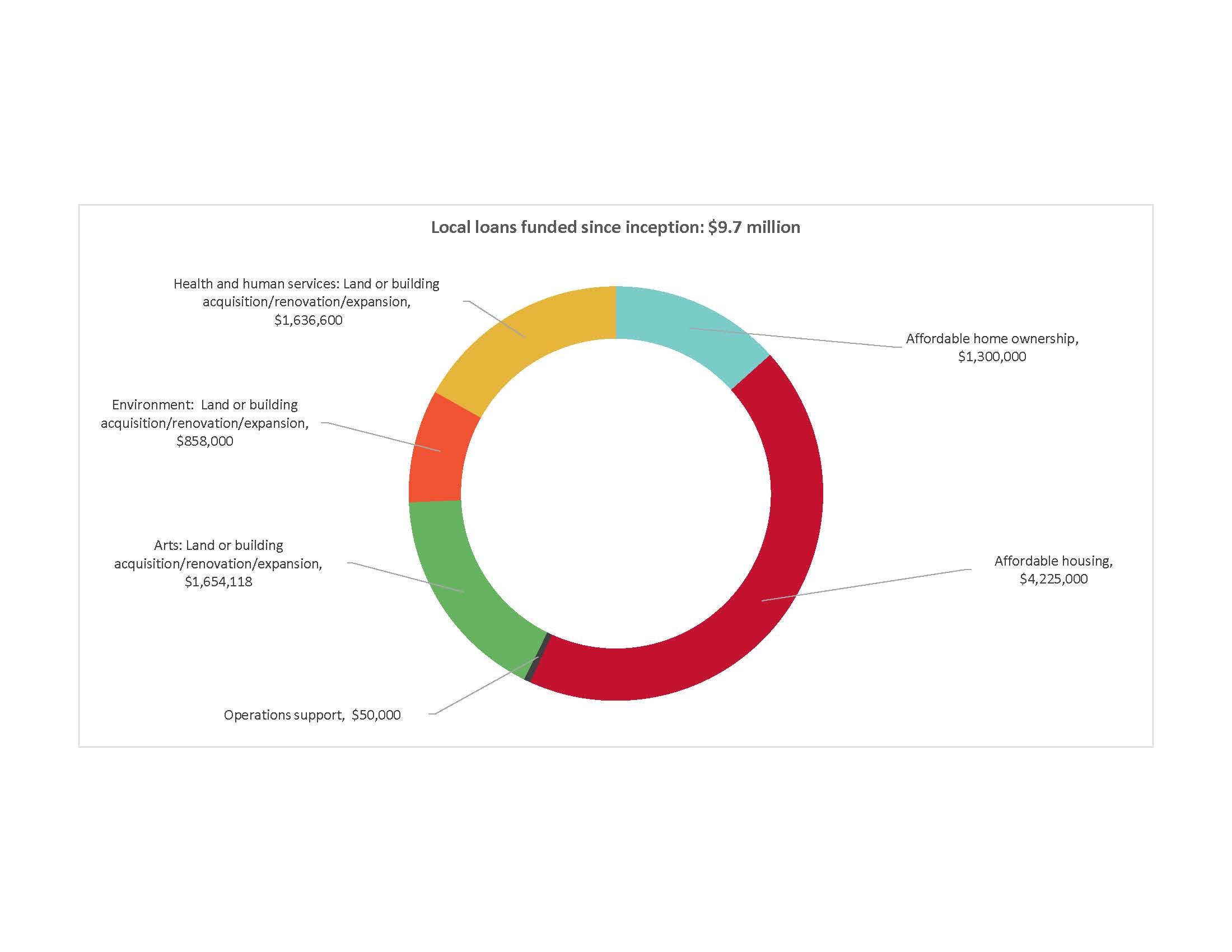
Local loans since inception total $9.7 million with $7.1 million outstanding at year end. Chart 6 shows the impact areas our loans have supported. Since the loan program’s 2012 inception, $2.6 million in loan principal has been repaid and recycled as new loans. In addition, the interest from these loans supports HCF granting.
Chart 6
IRP is a Government of Canada program being delivered nationally by partners including Community Foundations of Canada. As the first phase in the government’s long-term investment in social finance, the IRP’s goal is to make social-purpose organizations “investment ready” so they can make a difference in new and innovative ways through their participation in the social finance market. HCF has partnered with community foundations in London and Niagara, and the McMaster Innovation Park to manage the program regionally on behalf of Community Foundations of Canada. The first request for proposals for funding in January created enormous interest nationally and garnered 65 submissions to our regional partnership. Approved funding is expected to be released in June 2020. As an additional benefit, the IRP brought a growing number of potential opportunities for local loans to HCF’s attention.
These investments include private equity, private debt and real estate investments. Many of these investments are long term in nature, are maintained at cost and do not have a regular income stream. As these investments are maintained at cost, their results include interest income and realized gains, but not unrealized gains. Results for these investments are closely monitored and are reported when realized. Chart 7 identifies the investment areas, with $18.0 million placed and a total commitment of $33 million across 21 investments.
Chart 7
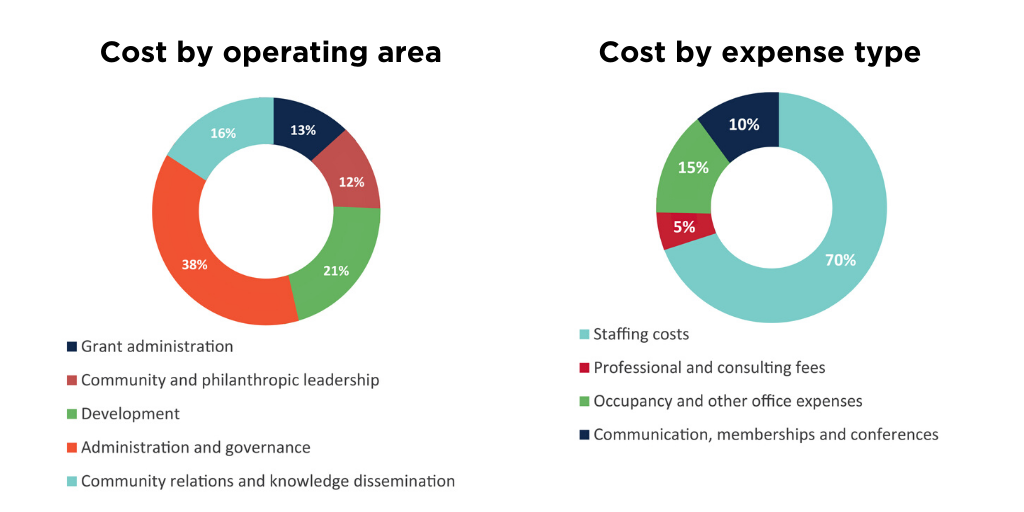
Operating expenses for the fiscal year ended March 31, 2020 total $2.5 million and were 2.5 percent higher than last year. Staffing costs related to the Foundation’s 22 employees represent 70 percent of HCF operating costs.
In addition to breaking out cost by type, operating costs are allocated to each of the Foundation’s operating areas: grants administration, community and philanthropic leadership, community relations and knowledge dissemination, development activities, and administration and governance. Examples of community and philanthropic leadership include convening around the city’s critical issues and fostering the growth of philanthropy by sharing staff time and knowledge to support other charities. Charts 8 and 9 illustrate these costs by operating area and by expense type.
Charts 8 and 9
The Foundation’s annual development expenses are not necessarily attributable to the donations received in that year. The nature of donations to the Foundation can result in costs preceding the receipt of the donation by several years (for example, donations through wills). As a result, consistent with the community foundation sector, operating costs are evaluated by a ratio of total operating expenses to average total assets. Ratios fall within a range depending on the size and stage of the community foundation’s development.
Management considers the ratio of 1.26 percent (1.25 percent in 2019), as illustrated in Chart 10, to be within an acceptable range for a foundation of HCF’s size, stage and level of community leadership, compared against benchmarks established in the community foundation sector. We continue to monitor both the actual results and the benchmarks on an ongoing basis.
Chart 10

Hamilton Community Foundation’s total assets of $201 million at March 31, 2020 include balances of HCF funds and funds held on behalf of others at $1.7 million.
Hamilton Community Foundation’s fund balances, illustrated in Chart 11, represent accumulated donations plus the net investment earnings on these donations, minus granting and operating costs. Funds include both endowed and flowthrough funds. Endowed funds are held permanently and grant from investment earnings. Flowthrough funds are fully distributed as grants over a pre-determined term.
Chart 11
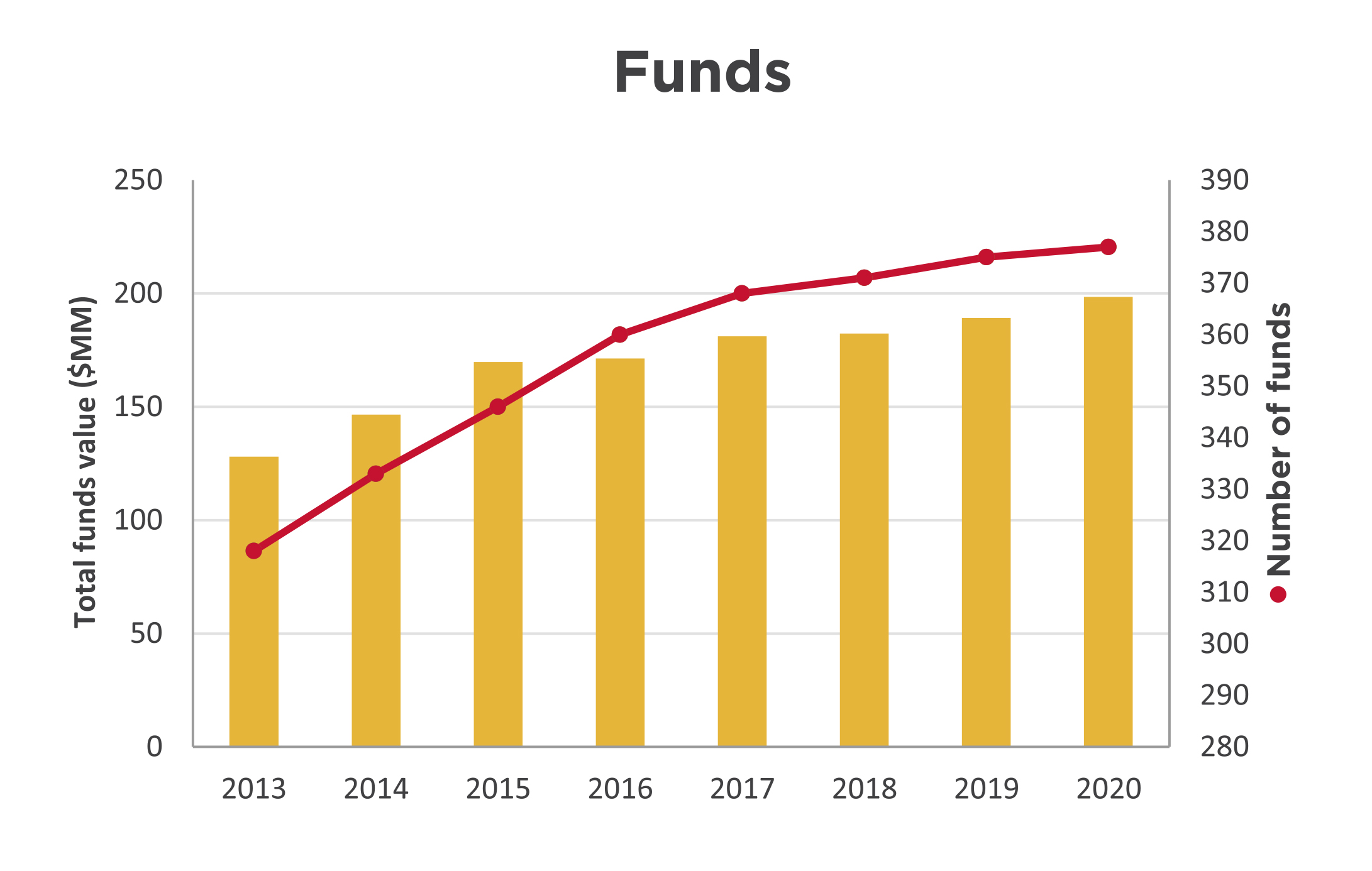
The fund balances have grown 55 percent to $198 million at the year ended March 31, 2020 from $128 million in 2013. Donations of $35.1 million included $4.4 million in flowthrough donations that were largely distributed as grants in the year and, as a result, do not remain in the fund balances at year end. This results in a modest total funds balance growth of 4.8 per cent for the year. The number of funds has grown 19 percent to 377 from 318 in 2013.
 Donate Today