Chris Farias and Jared Lenover celebrated their wedding by setting up a fund at HCF to support organizations making a difference for gay and lesbian youth.
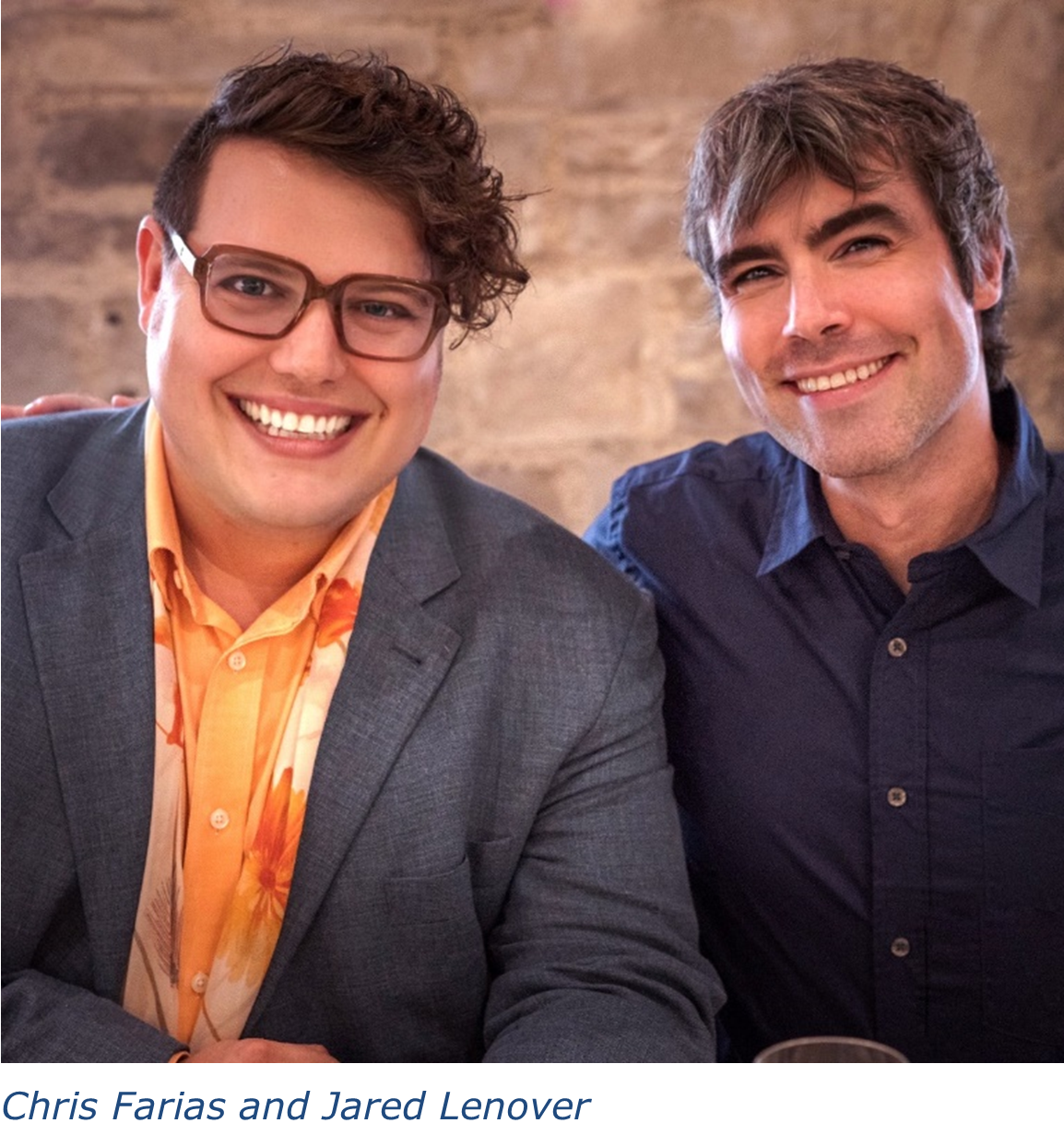
“We weren’t exactly kids when we got married; we didn’t need toasters,” Chris says, so they encouraged friends to launch the fund with their gifts instead. That was in 2018 and they have not looked back.
Both grew up in rural Ontario and suffered from a lack of gay role models and visible representation. They hope they can change that for kids coming up now.
“How can we empower 2SLGBTQIA+ youth? Can we take down a barrier that is holding someone back?” says Jared about the impact they would like to see from their fund.
The Unicorn Fund (“mythology tells us there is no more powerful force than an unchained unicorn,” explains Chris) has grown faster than the couple anticipated. In a conscious strategy to link their values and work, their branding company builds a donation to the fund into every contract.
“We are unapologetically committed to this,” says Jared. “So we just tell clients in advance that part of their payment for work by our company, Unicorn Rebellion, will go to the fund at HCF to help 2SLGBTQIA+ kids. The response has been overwhelmingly positive.” In addition to corporate contributions, Chris is a born fundraiser. He maximizes opportunities on Facebook, drag performances and other speaking events to raise donations for The Unicorn Fund and other local charities.
The couple says Hamilton Community Foundation has been a great partner. “They are fantastic people, progressive and embracing of everyone,” says Chris. “As an organization, HCF has seriously put a focus on diversity and inclusion,” Jared adds. “They are doing the work. You need to, to be effective in Hamilton and reflect the whole community.”
“HCF has seriously put a focus on diversity and inclusion. They are doing the work.” – Jared Lenover
Jim Ray wishes he had found Hamilton Community Foundation sooner. After years of giving to causes they believe in, Jim and his wife Annette established a donor-advised fund at HCF. They now feel they can achieve even more with their resources.
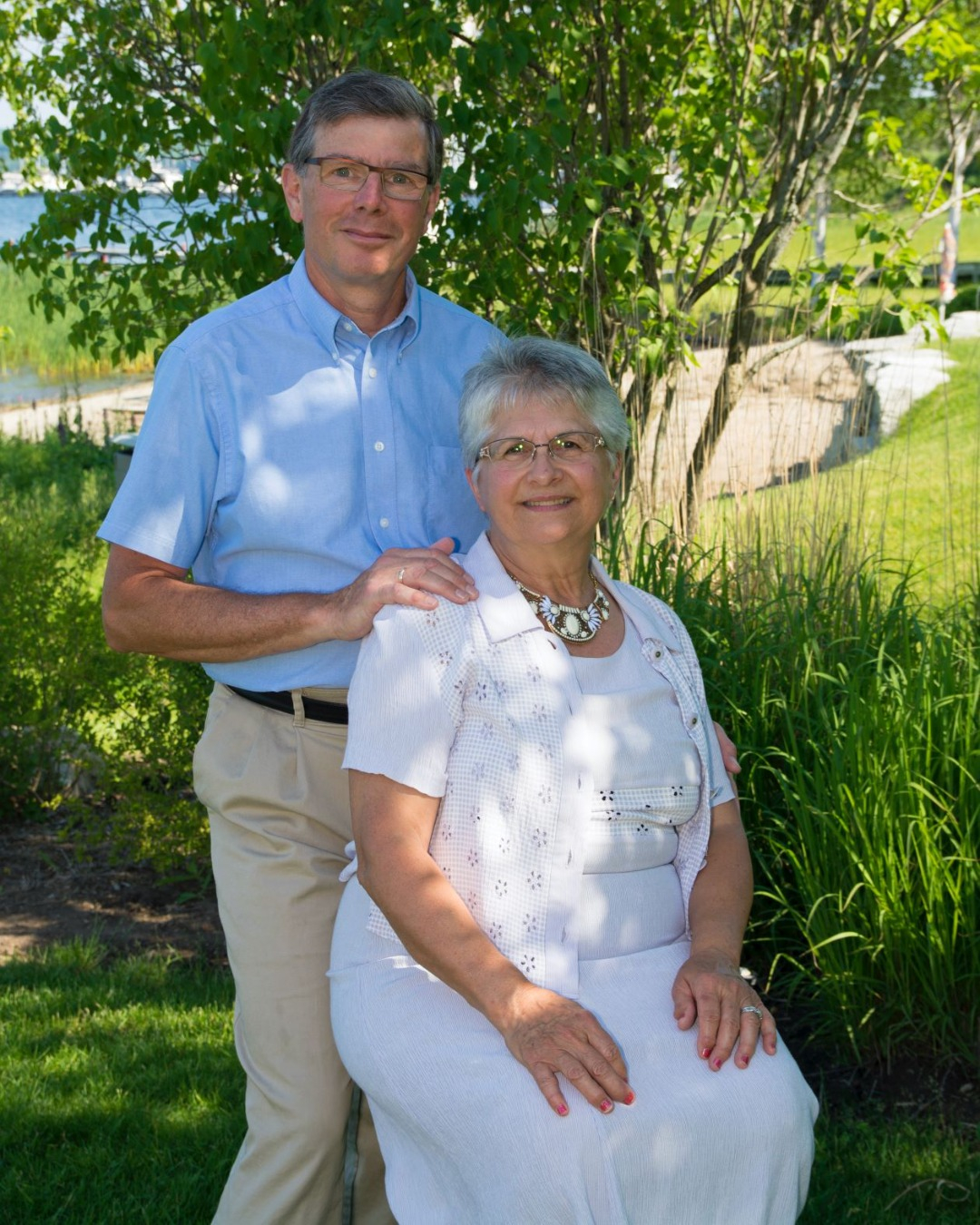
Their fund at HCF offers them “huge flexibility and simplicity,” says Jim. The couple also appreciates the Foundation’s expertise identifying community needs. As they continue to support long-standing interests including the French parish, youth opportunities and the arts, Annette says HCF offers them “research and analysis and a perspective on community needs that we wouldn’t have on our own.” The Foundation has already matched them with new opportunities for impact, including exciting work with Indigenous communities.
HCF’s tax and financial expertise (“the mechanics”, as Jim calls it) is also a bonus. For example, donating stocks can provide tax advantages, increasing the value of the gift. “It’s real magic, but a bit complicated,” Jim says. “It’s not fair to expect the volunteer treasurer of a charitable organization to know the ins and outs of that. But the Foundation does, and by donating those shares to them, we can maximize our support to the organizations we want to help.”
The Dufresne-Ray Family Fund is an endowed fund, which means it will make a difference in perpetuity.
“Perpetuity is a long time,” says Jim with a smile. “The organizations we support right now may not be around decades in the future.” Their fund, however, is designed to continue to support the interests and priorities that Jim and Annette care so much about now — and eventually with added input from their children and grandkids.
“Our intentions will continue to be met over time,” says Annette. “That gives us comfort. And all the staff at the Foundation have been compassionate and meticulous. They’ve been a pleasure to deal with.”
“The Foundation offers a perspective on community needs that we wouldn’t have on our own.” – Annette Ray

Brad is a single dad who lives with his five children in an apartment in east Hamilton. His landlord refuses to spray for bugs, conducts illegal inspections and is making Brad pay for damage that predated his move-in. Now, the landlord is putting pressure on Brad to move. “I don’t want to,” Brad says. “He calls me the R-word. I’ve heard that word all my life. It makes me want to cry.”
Brad credits Civic Connections — a program that uses community outreach, tenant workshops and leadership development to increase the civic engagement of Hamilton’s low-income tenant community — with giving him the confidence to stay put.
HCF first funded Civic Connections in 2017. Subsequent grants have supported the program’s expansion in several neighbourhoods experiencing escalating pressures from gentrification, including those in east Hamilton and on the Mountain. In 2021, the program will continue in east Hamilton and expand to four new west Mountain neighbourhoods and one in the core, again with HCF support.
More than 60 people attended the tenant workshops in 2020, which were developed with the support of the Social Planning & Research Council of Hamilton and the Hamilton Community Legal Clinic, and held online due to the pandemic. Participants learned the basics of municipal government, practised presenting to city council and were informed of their rights and obligations, with special attention to evictions during COVID-19.
Elizabeth Ellis co-led the east Hamilton workshops. Like Brad, she had been bullied by her landlord to leave, eventually accepting a buy-out that wasn’t enough to cover her moving costs, let alone the rent increase at her new place. “Knowledge is power,” Elizabeth says. “We give people information so they can decide what’s right for their situation. The more people speak up, the more city hall will listen.”
The ultimate goal is constructive civic engagement. “An informed citizenry makes better decisions,” says Hamilton Community Legal Clinic staff lawyer, Ali Naraghi. “If the public knows their basic rights on any topic, it automatically de-escalates conflict down the road.”
ABACUS is HCF’s initiative to engage middle-schoolers and increase the likelihood that they will graduate and go on to postsecondary education. At Boys and Girls Club of Hamilton, it means providing the experiences and supports to spark kids’ interest in learning and help them achieve their educational dreams.
Like all programs at the club, ABACUS creates a space where young people want to be. “That’s our secret sauce,” says assistant executive director, Duane Dahl. “Members feel safe to try something new because it’s low commitment. No one tells them they have to come.”
In March 2020, in-person gathering was restricted and all the tried-and-true ways to connect and engage with young people disappeared overnight. Staff scrambled to reinvent the program, constantly figuring out new ways to connect, especially with those they hadn’t seen. The kids’ mental health and well-being were paramount.
A twice-weekly after-school drop-in moved online. Mentoring now takes place by phone, on Instagram, during meet ‘n’ greets in local parks, private chats on Zoom and curbside pickups of pre-made dinners and grocery cards. Field trips are now virtual, including a workshop for middle-school girls with musician Queen Cee, a special event with international TikTok star Notorious Cree and a virtual meetup with youth from the Montréal Boys and Girls Clubs.
Recognizing that ABACUS programming deals with a vulnerable group, HCF enabled grantees to redirect funding to meet the challenges posed by COVID-19. At the Boys and Girls Club, this meant food security, connection and community took precedence over academics.
“We started the food program because we wanted the kids to know we weren’t going anywhere,” says manager of community services and programs, Heather Steeves. “You don’t have to join a virtual program for us to care about you and support you with what you need.”
“HCF trusted us to meet the needs that were being presented,” Duane says. “We’re providing direct supports like grocery cards, meals and school supplies, because we’re those trusted adults when families don’t know where else to turn.”
“Knowing this program still exists, even though it doesn’t look the same, that staff are there who care, it’s never been needed more than now.” – Heather Steeves, Boys and Girls Club of Hamilton

During week one of Art to Heart, Julie Turner explored her personal take on creativity. In week two, she made a collage expressing appreciation for her hands. Week three was scribble night. “That week I learned it’s okay to not have control,” says the St. Joseph’s Home Care employee. “I’m seeing lessons in the fun.”
Art to Heart, a no-cost, eight-week online art program developed by Dundas Valley School of Art, provides a safe gathering place for those working in Hamilton health-care settings to create therapeutic art projects and explore the impact of the pandemic on their lives. Funding came from HCF’s Pandemic Response Fund.
Some quick number crunching by DVSA determined that almost 20 percent of Hamiltonians are connected to health care. “They’re going into a war zone,” says DVSA executive director, Claire Loughheed. “The whole idea of Art to Heart is to create the opposite experience. Sometimes the power of making art is realizing the potential for joy.”
To accommodate shift work, participants can attend any of the weekly online sessions and access videos of missed classes. Activities are designed for people who don’t self-identify as artists and have limited time and focus. All materials are provided for free. Classes are facilitated by an art therapist.
All 60 spots were snapped up one week before the first class, with a waiting list of 60. DVSA will eventually post short, professional-quality lessons online so they’re available to anyone, anywhere, for free.
Julie doesn’t need to talk about work each week to experience support — making art is enough. “Sometimes you don’t realize what’s coming out until it’s on paper,” she says. “We feel safe to share about our projects because we’re all in health care. The pandemic has turned my job upside down. The day after a class, I’m able to cope better.”
“Creative endeavours are all therapeutic whether you set out for them to be or not,” says Claire. “This is a gift we needed to offer the community.”
“This was more than just saying the words ‘health-care heroes’. It was tangible. It told us the community cares about our efforts.” – Julie Turner, Art to Heart participant
Excerpt from 2021 Annual Report

A beautiful mural fills the wall of the EduDeo building on Barton Street East. When it was painted in 2016, its vivid blue sky, orange monarch butterfly and green cityscape overlooked a sad patch of black asphalt. People would stop, but there was no reason to linger.
That all changed last fall, when a Green Venture Depave Paradise project transformed the small former parking lot into an Instagram-worthy greenspace with native plantings, educational signage and a permeable surface seating area.
A total of 89 m2 of asphalt was removed, allowing 364,000 litres of stormwater to be absorbed annually — an important benefit in Hamilton’s lower city, where stormwater and sewage share the same pipes and sometimes overflow.
But the location was chosen for more than its positive impact on water quality.
“When we transformed this derelict block of cement with no soul, suddenly people said ‘wow, someone cares about this neighbourhood. Someone cares about me,’” says Barton Village BIA executive director, Rachel Braithwaite. “People start to think ‘maybe I could make a difference.’”
Over three days, community volunteers wearing masks and practising physical distancing filled a 20-yard dumpster with pre-cut asphalt and planted more than 130 plants.
“Depave Paradise is about community members freeing the soil with their own hands and observing the transformation,” says Helena Cousins of Green Venture. “It’s about people stopping, learning, thinking and getting involved.”
A local landscape architect with expertise in stormwater management was an important champion, and local businesses chipped in with in-kind donations. The project, which was two years in the making, gained momentum with a grant from HCF.
“HCF was the first one in the door,” says Ryan Geleynse of EduDeo. “They laid the foundation so we could build from there. It’s invaluable.”
The EduDeo site is only the beginning. “The community envisions a chain of greenspaces along Barton,” Helena says. “It’s a jam-packed street. People need a pause in the pavement.”
“Part of believing in yourself is believing in your community and what it could be, not just what it is or what people tell you it is.” – Rachel Braithwaite, Barton Village BIA
Excerpt from 2021 Annual Report
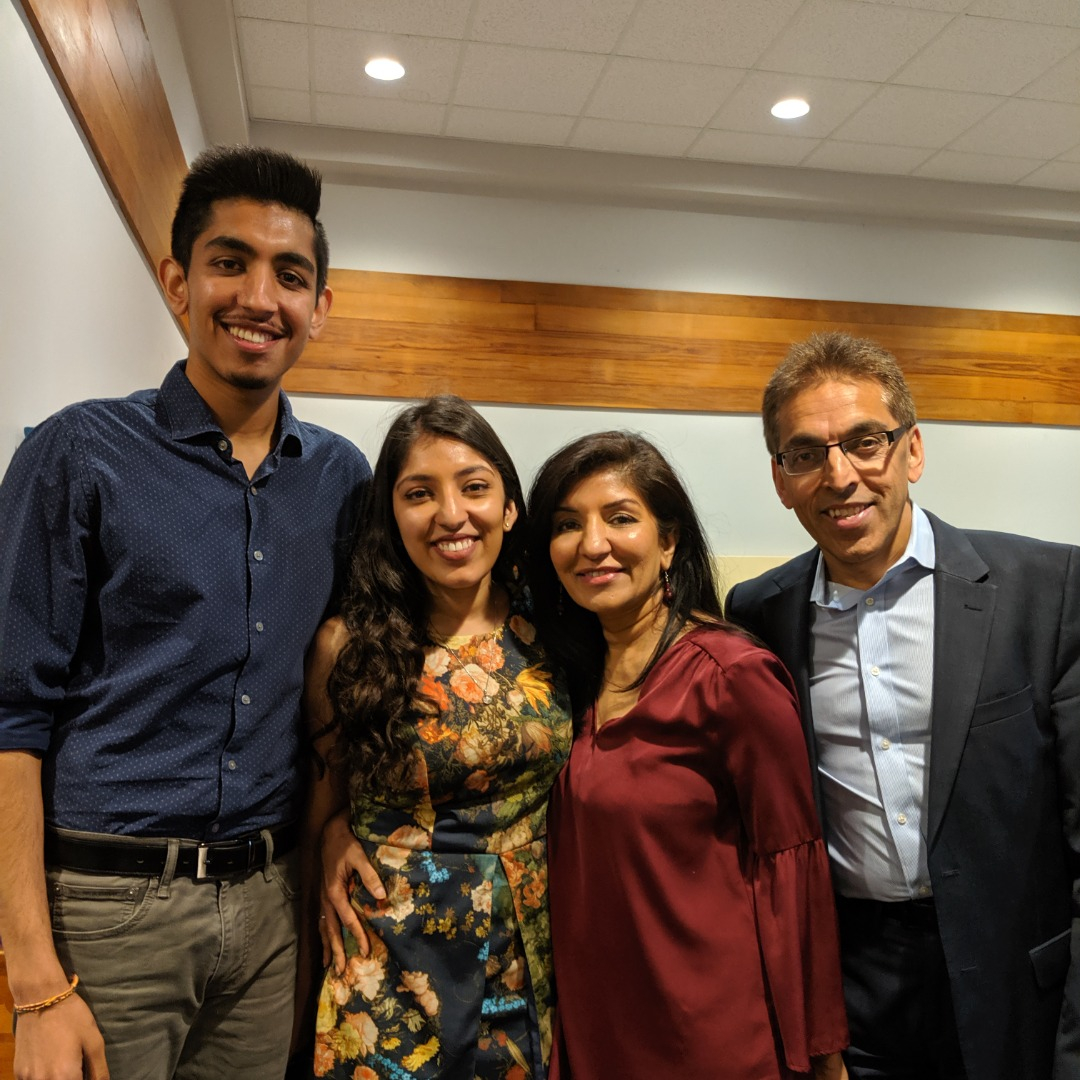
Like many people, Upkar and Nita Arora felt they had taken care of basic planning — they had wills, insurance and health powers of attorney. But then, an urgent medical issue raised the stakes.
“It forced us to revisit our goals,” says Upkar, “and really talk about how to have an impact with our estate.” They especially wanted to engage their children in the family’s future philanthropy.
They chose Hamilton Community Foundation as their partner “for three reasons,” says Upkar: the quality of its leadership, its innovation and creativity in addressing root causes of inequity, and its responsiveness and ability to act quickly in their particular circumstances.
Nita and Upkar worked with HCF to create the Arora Family Fund, and with input from their daughter and son — both in their 20s — put together its statement of purpose. The fund will focus on improving the lives of individuals in disadvantaged communities, including the needs and inequities that have surfaced so clearly in the COVID-19 pandemic. It aims to tackle barriers that marginalized populations encounter, and create opportunities for inclusion and success.
“Serena and Sahil are active in social justice issues and both suggested changes to what we were proposing,” says their father. “They are equal members of the fund’s advisory committee with Nita and me.”
Philanthropy is a family tradition: earlier generations on both sides of the family instilled the values of giving and volunteering. “It’s etched in our upbringing,” says Upkar. The couple always expected to use their estate, whatever size it might be, to take care of community needs as well as their children. But this recent experience shone a different light on it.
“Why wait until after you’re gone?” says Upkar, “especially when community needs are so significant. By doing something now, you can see the difference you’re making and engage the whole family in carrying on the tradition of giving.”
Cheekbone Beauty’s founder, Jenn Harper, wants to own the first Indigenous billion-dollar beauty company—but her dream is about more than money.
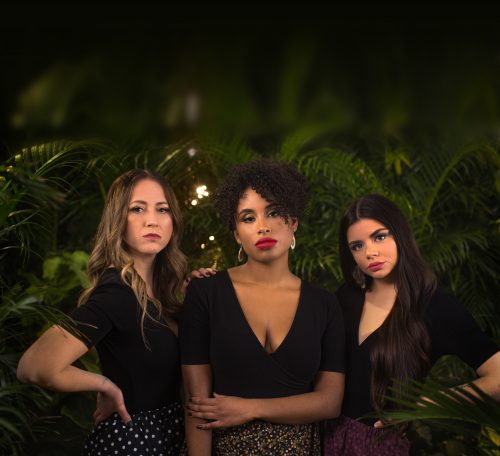
“This is about our communities. It’s about our people,” Jenn says. “I want every Indigenous kid across the entire planet to see our product on a shelf and say, ‘Another Indigenous person did that.’”
Jenn’s company is one of six Indigenous enterprises to receive between $250K and $2M in equity from Raven, the world’s first Indigenous impact fund. The objective of the fund is to support innovative, scalable, purpose-driven Indigenous businesses to reduce poverty, create employment and improve the quality of life of Indigenous Peoples across Canada, while generating a target return of six to eight percent for investors.
“The fund is about economic reconciliation,” says Paul Lacerte, managing partner of Raven. “We’ll know we’ve achieved it when Indigenous people aren’t managing poverty, they’re managing wealth.”
With more than 60,000 Indigenous entrepreneurs across the country, there’s no shortage of desire and drive. But lack of access to financing limits growth. So do structural inequities such as regulatory barriers, systemic racism, intergenerational poverty and a lack of financial literacy. Raven’s approach, which is based on the Seven Sacred Teachings and aligned with the UN’s Social Development Goals, provides more than just venture capital.
“We’re in business together,” Paul says. “All of the CEOs have said the cultural support they get is more valuable than the money.”
Raven is part of Hamilton Community Foundation’s impact investing portfolio—investments that deliver financial returns coupled with positive social and/or environmental outcomes.
“Raven exemplifies the kind of impact we want to make with our investments and the kind of systems change we believe is possible,” says Annette Aquin, HCF’s Executive Vice-President, Finance & Operations. “It presents a remarkable opportunity to change the way we look at ‘returns.’”
For Paul, the big dream is an Indigenous economy in the image of Indigenous cultures. “We’re replacing a capitalist and colonial mindset with a collaborative and regenerative mindset,” he says. “We’re transforming money from a force that hurts into a force that heals.”
Excerpt from 2021 Annual Report
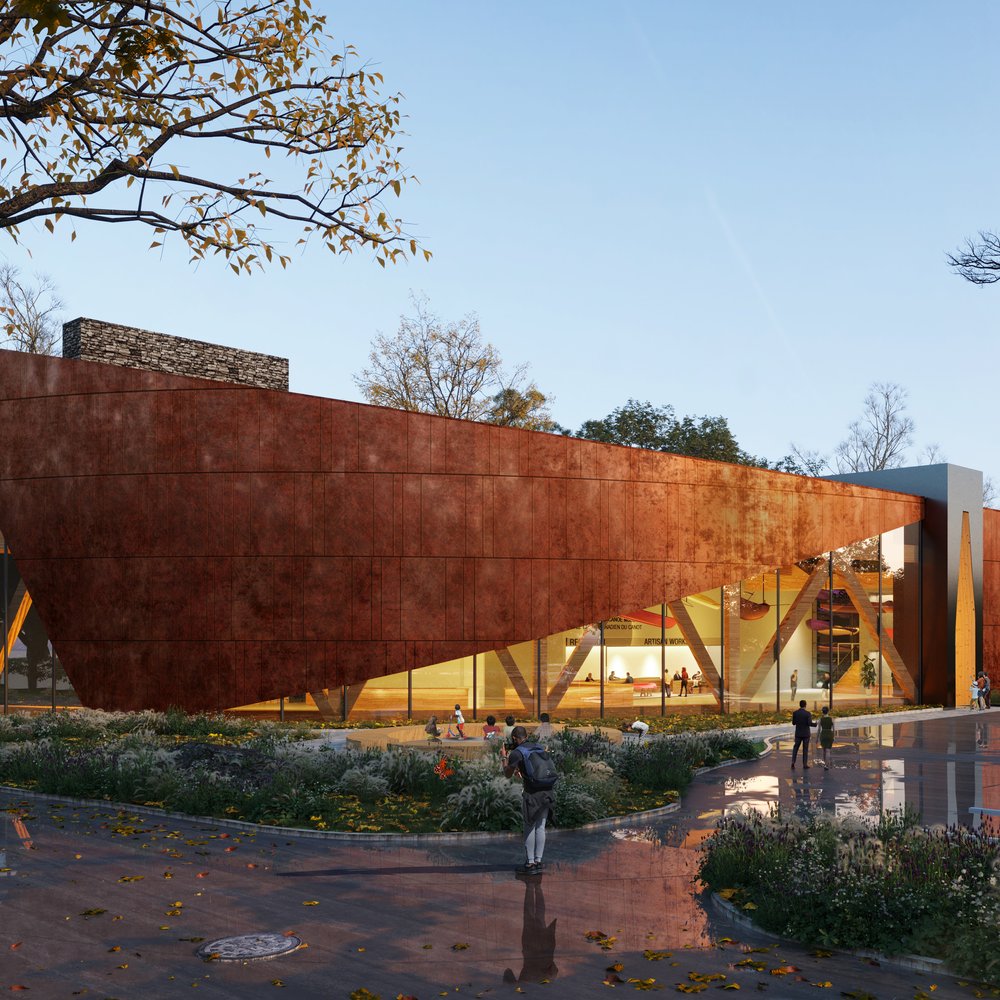
A canoe can take you many places — and only some of them are on a map.
The Canadian Canoe Museum’s collection of 650-plus paddled watercraft helps visitors explore Canada’s culture, art, heritage and spirit, as well as find routes to reconciliation with Indigenous peoples. It’s a journey that’s about to become more meaningful, thanks to a $40 million campaign to build a new, 65,000 square-foot home on the shores of Little Lake in Peterborough, a mere four kilometres from the museum’s current cramped, landlocked location.
Support has come from all levels of government, foundations, businesses and individual donors. As part of its commitment to impact investing, HCF invited community foundations from across Canada to pool capital for a loan to the museum. HCF arranged two guarantors for the loan, removing much of the risk. Five foundations joined in, including the Community Foundation of Greater Peterborough.
“One of the goals of our impact investing strategy is to grow the capacity of other community foundations to participate,” says Annette Aquin, HCF’s Executive Vice-President, Finance & Operations. “We take on the due diligence and legal co-ordination to make it easier for them to say yes, particularly smaller foundations.”
The museum’s Executive Director, Carolyn Hyslop, says HCF’s involvement was key to bringing the community foundations together to support the project. “We needed someone on the inside to lead the process,” she says. “HCF’s experience with how to strategize, reach out and communicate — it’s magic.”
The loan provided much-needed capital and became a vote of confidence that helped the museum attract other investors.
The experience, which Carolyn describes as robust and thorough, felt different from traditional financing. “It felt good because it wasn’t just about our project proposal,” she says. “It was also about our intentions.”
Excerpt from 2022 Annual Report
The distance between Kaew Luerueng’s life in Thailand and life in Hamilton is better measured in dollars than miles.

That’s because finding the money to recertify as a nurse was the hardest part of her journey. “I was living paycheque to paycheque,” Kaew says of her time working as a personal support worker. “Whatever I earned, I sent back home.”
Thankfully, a low-interest loan from Windmill Microlending allowed Kaew to enroll in the Bridging for Internationally Trained Nurses at Mohawk College, and today she’s an operating room nurse at the Hamilton General Hospital. “That loan helped me the most. Ten thousand dollars is a lot of money.”
Founded in 2004, Windmill is a registered charity that offers microloans to help skilled immigrants and refugees continue their careers in Canada. Loans of up to $15,000 pay for training, exams, living expenses and other career advancement costs. Client support coaches offer encouragement and resources, such as financial literacy training. Many Windmill alumni become mentors, helping current clients with professional networking. The loan repayment rate is higher than 98 percent.
Unemployment among Windmill alumni drops to seven percent from 40 percent. Even better, incomes are permanently tripled, says Sarah Stuewe, Windmill’s associate director of philanthropy. “That’s life changing. And it’s only the start, since the average age of clients is 36 and they’re likely to get promotions.”
Windmill currently approves more than 1,000 loans each year. By 2025, given Canada’s ambitious permanent residency targets, they’d like to quadruple that number. Money for loans comes from donations – such as The Young Fund at HCF – as well as from investments in Windmill’s Community Bond Fund; in 2019, HCF invested $1.0 million in the fund, which was the largest single investment in Windmill to that point. “HCF’s investment helps open doors with other potential investors,” Sarah says. “The impact investing community is small, so those endorsements are important.”
Kaew is one of 73 alumni and current clients from the Hamilton area. Fifty-nine percent are recertifying for careers in health care and 18 percent in IT and engineering. “Our alumni are on the frontlines of this pandemic, helping Canadians through the crisis,” Sarah says. “But even before the pandemic, they were addressing acute labour market shortages.”
Excerpt from 2021 Annual Report
Donations to the Foundation are invested for the long term in public markets and in alternative investments. Investment income is then allocated annually to support granting, community leadership and operations. The summary and charts presented here provide both a financial snapshot and a history of recent activity that underlies the grants and community leadership activities represented in this annual report, made possible by remarkable donors.
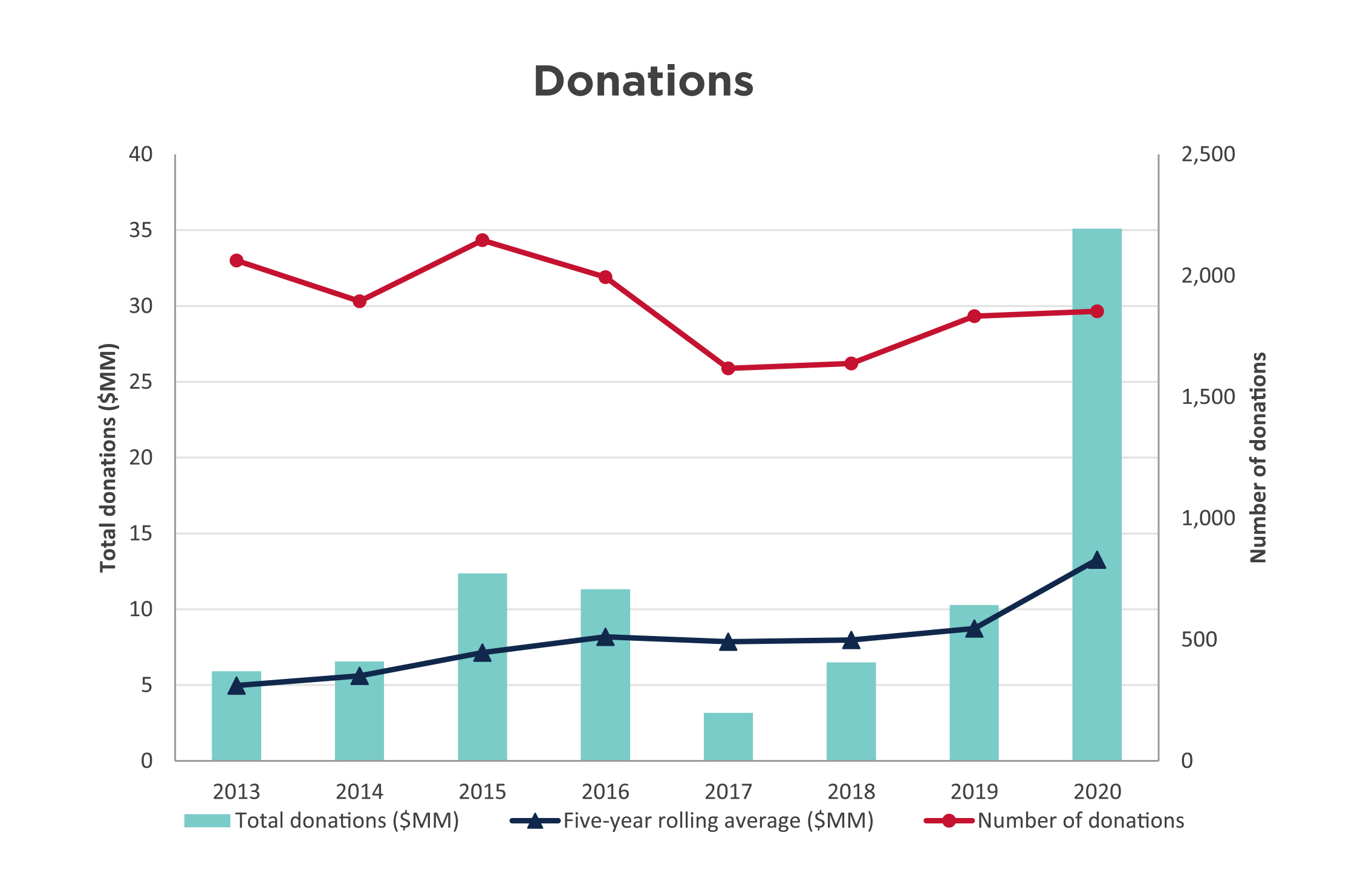
Donations to the Foundation are from individuals, corporations and other charities. Donors may contribute to named endowment or flowthrough funds, to the Board-directed Community Fund, or to HCF’s community leadership projects.
The $35.1 million in donations this year is the second highest total in HCF’s history. Annual donations are influenced by the timing of the realization of donations in wills and significant one-time donations like the $27.7 million in donations of property and private equity. As illustrated in Chart 1, annual donations have ranged between $3.2 and $35.1 million over the past eight years. The five-year rolling average of donations ranges from $5.0 million to $13.3 million over the past eight years.
The five-year rolling average number of donations is 1,787 with 2019-20 at 1,853. The number of donations fluctuates based on “in memoriam” donations and the number and nature of events sponsored by donors to raise money for their funds.
Chart 1
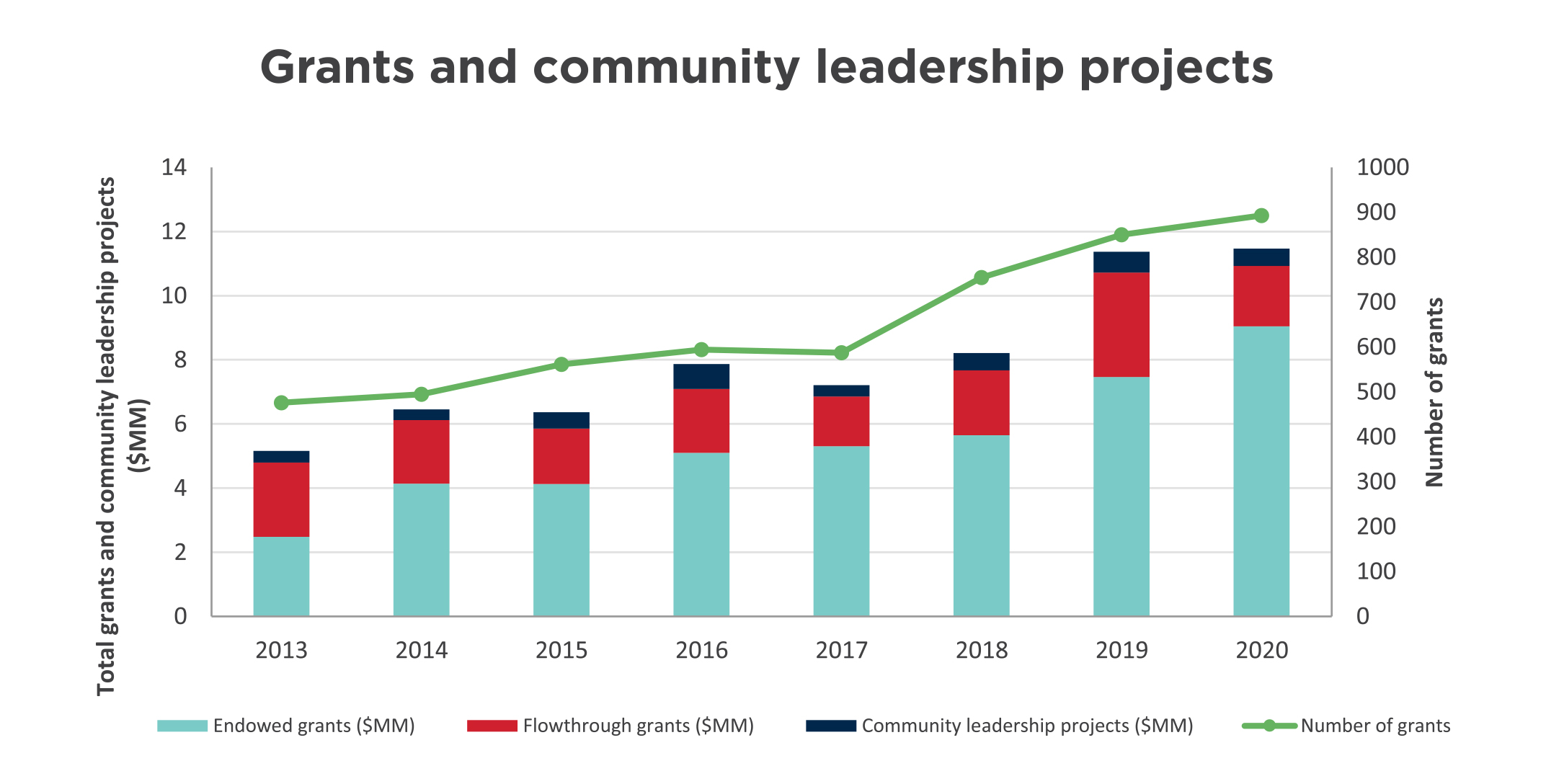
Grants are made annually from both endowed and flowthrough funds. Because flowthrough fund balances are distributed in a shorter time period, granting from these funds can materially influence HCF’s total annual amount granted.
As illustrated in Chart 2, grants and community leadership project spending over the past eight years has ranged from $4.7 million to this year’s historic high of $11.5 million. Granting from endowment funds was reduced in 2013 as a result of the decline in investment returns in 2012 which a) lowered the asset base used for the granting calculation (currently four percent of the fund balances), and b) resulted in less income available to grant. Flowthrough granting and expenditures on community leadership projects has ranged from 22 to 56 percent of total granting in any given year and is dependent on the timing and nature of flowthrough and project activity. At 893, the number of grants for this year is 37 percent higher than the eight-year average.
Chart 2
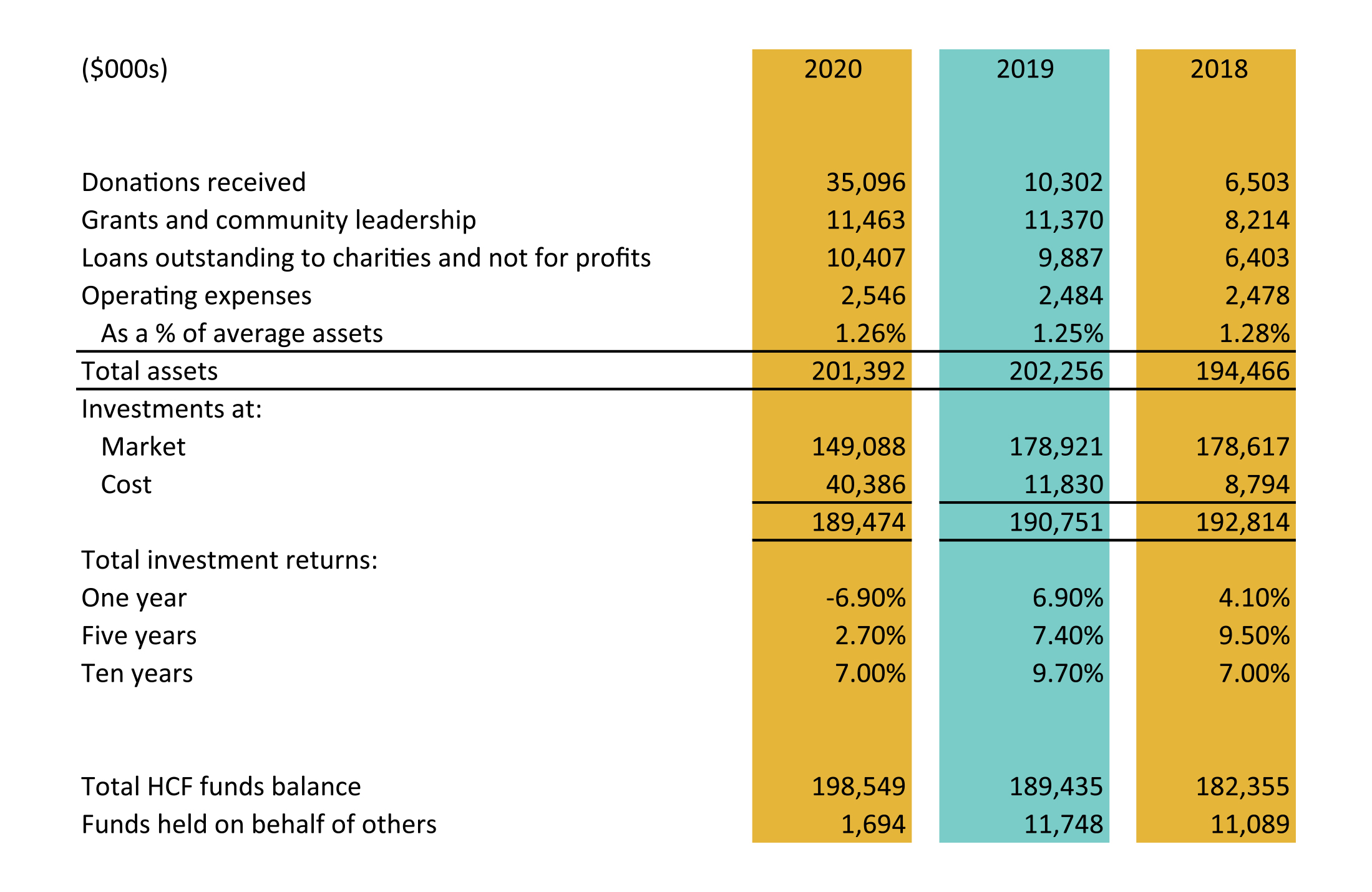
Investments traded in active markets are reported at fair market value. Investments not actively traded are recorded at their cost less any impairment of their value.
To support our strategy of aligning our assets with our mission and to provide a more diverse and robust portfolio, HCF has committed to investing in alternative asset classes including loans to charities and not-for-profits, private debt, real estate, infrastructure and private equity. These alternatives are consistent with the Foundation’s long-term investment horizon and liquidity requirements. Since these investments are not actively traded, they are valued at cost in the investments. These alternatives total $25.8 million.
HCF invests according to policy guidelines established by the Board of Directors. Two committees of the Board oversee investments to ensure compliance with the policy:
As an endowment builder, HCF’s policy focuses on long-term investing and is supported by reserve accounts that are currently at their policy maximum.
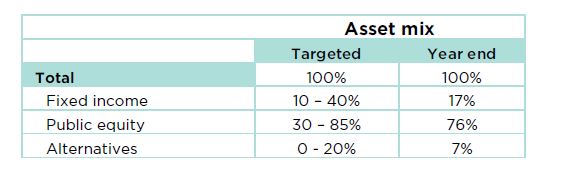
The investment policy sets out a total portfolio target asset mix, as well as a range around these targets. The public market investment managers have mandates within this targeted asset mix and use their discretion to invest the portfolios within this range. Chart 3 reflects the current and target asset mix. Note: $25 million of private equity relates to a fund established by a donor and is not part of the asset mix or the consolidated portfolio results.
Chart 3
Two long-term portfolios are invested in the public markets with Jarislowsky Fraser, and Connor, Clark & Lunn. Chart 4 compares those portfolios against benchmarks as follows:
Benchmarks reflect the performance of each market index based on HCF’s specific target asset mix. Comparing actual results to the benchmark measures the value added by investment managers compared to the average market performance. HCF’s investment policy target is a long-term investment return in the 6.5 to 7.5 percent range.
Chart 4
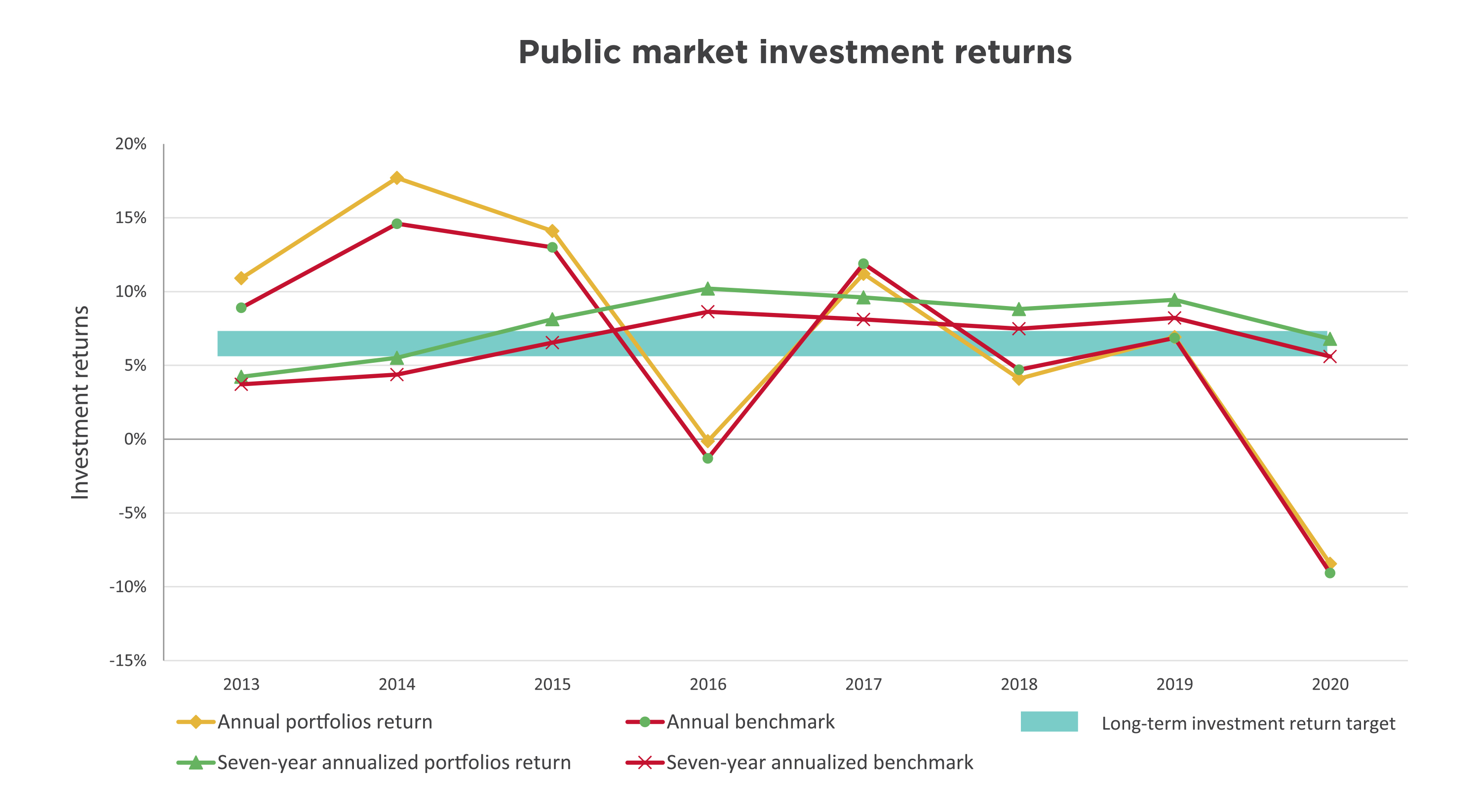
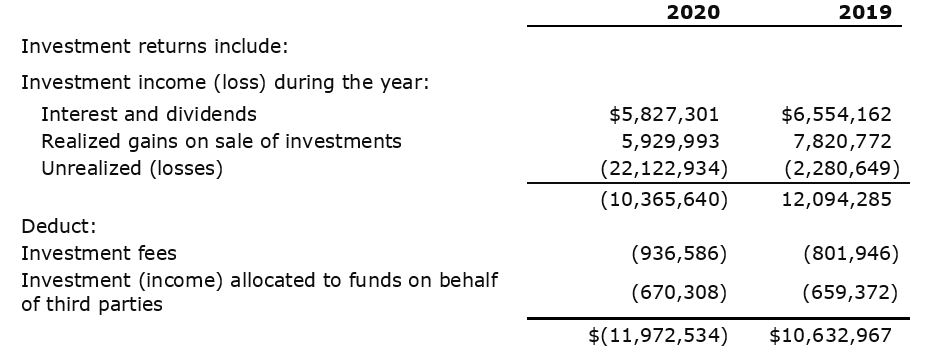
The effect of the global pandemic has materially affected investment returns, resulting in a -8.4 percent public market return for the year. The seven-year annualized return at 6.8 percent is within the targeted investment policy range and is 1.2 percent higher than the 5.6 percent benchmark. As noted in the financial highlights, the current 10-year annualized return of 7.0 percent is in the target range and is higher than the benchmark by 1.2 percent.
Impact investments enable donations to endowed funds to drive positive change beyond granting, because they represent investments of capital that deliver financial returns coupled with positive social and/or environmental outcomes. In addition, these investments provide a pool uncorrelated to the public markets which, in turn, buffers the portfolio from the volatility currently experienced.
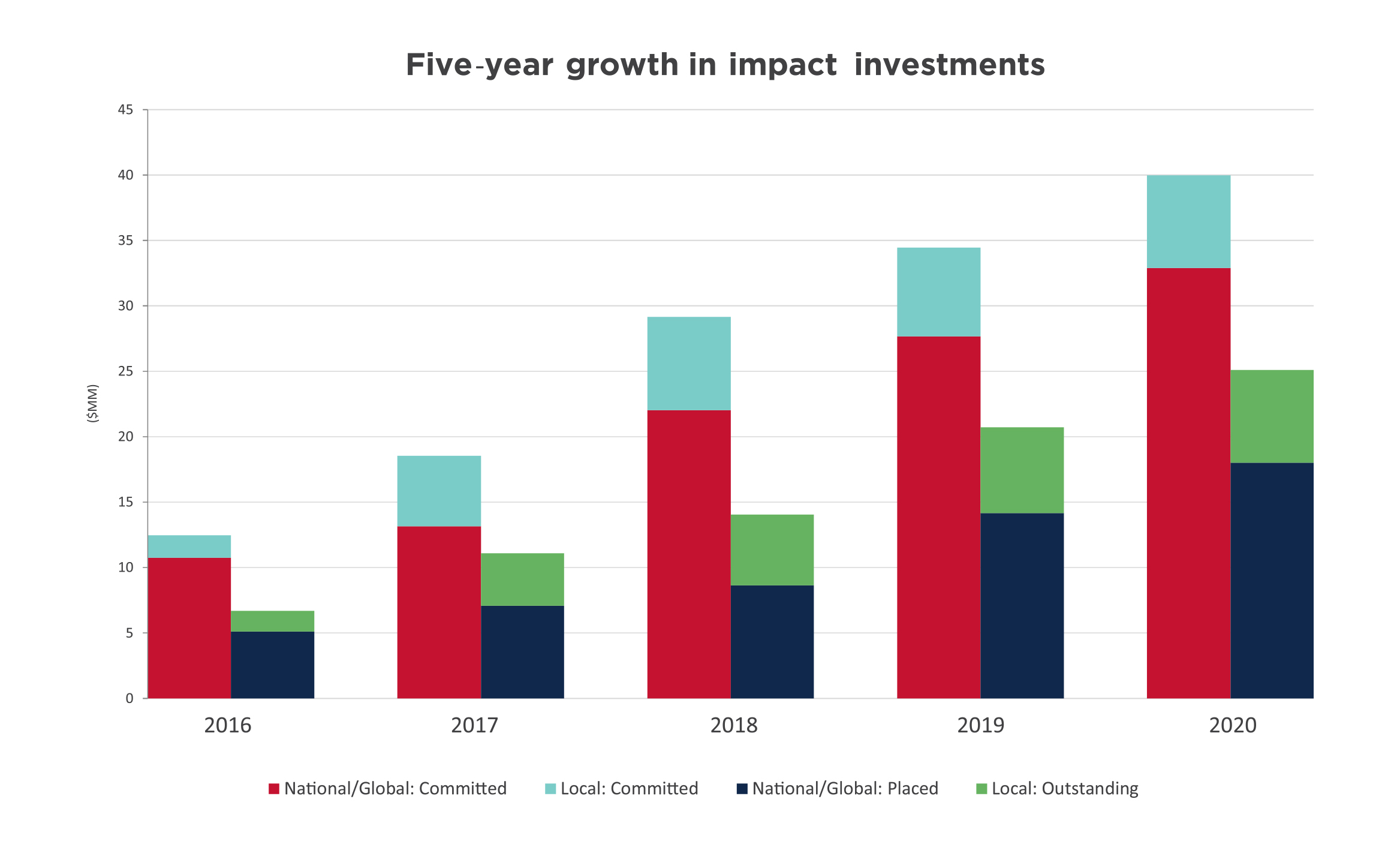
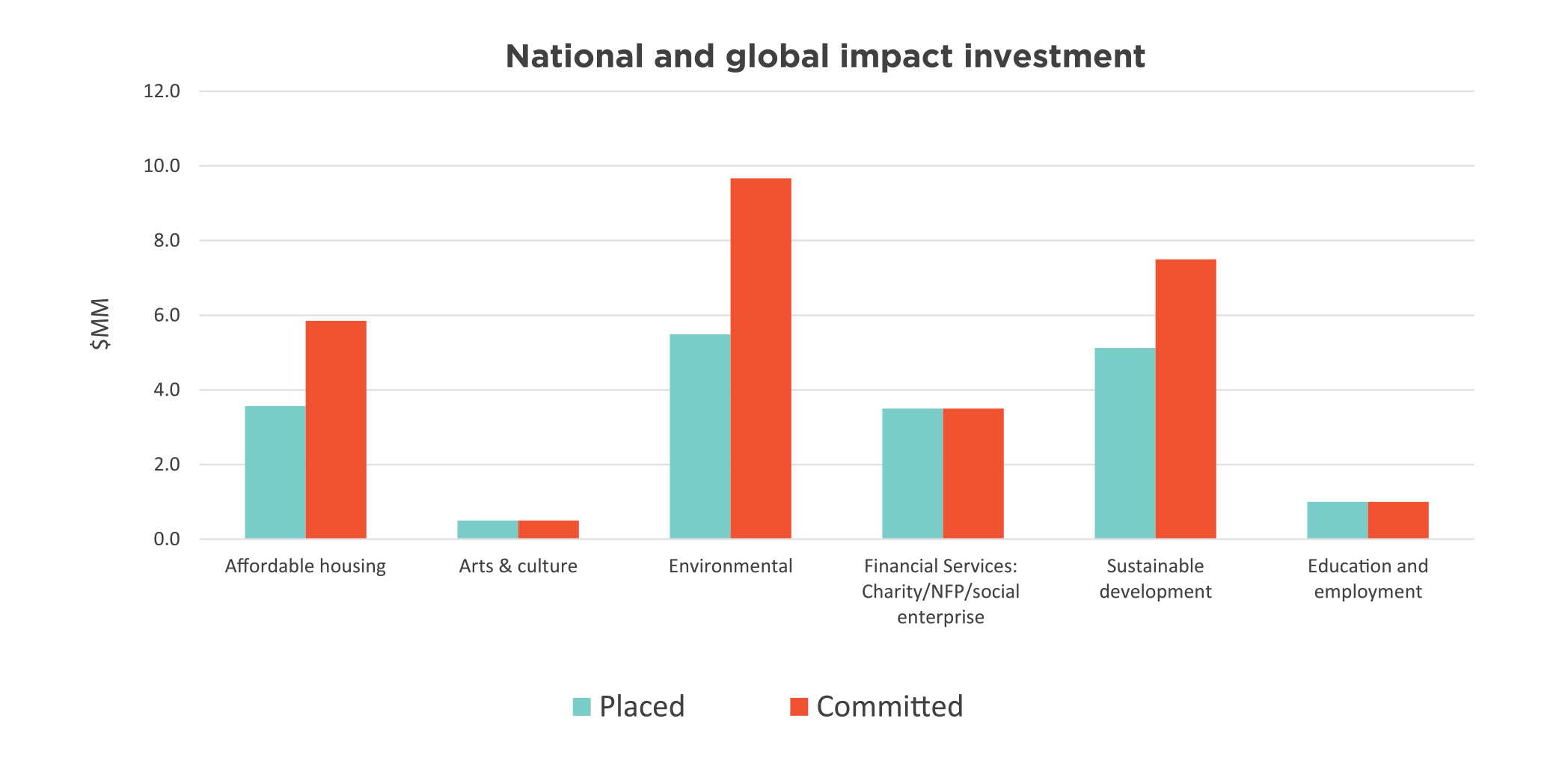
More than 15 percent of our long-term assets are in impact investments. Chart 5 illustrates HCF’s impact investing progress over the past five years, with $25 million currently placed or outstanding and another $15 million committed. This brings the total commitment to $40 million, up from $34 million last year. Impact investments cover areas including affordable housing, arts, environment and sustainable development.
Chart 5
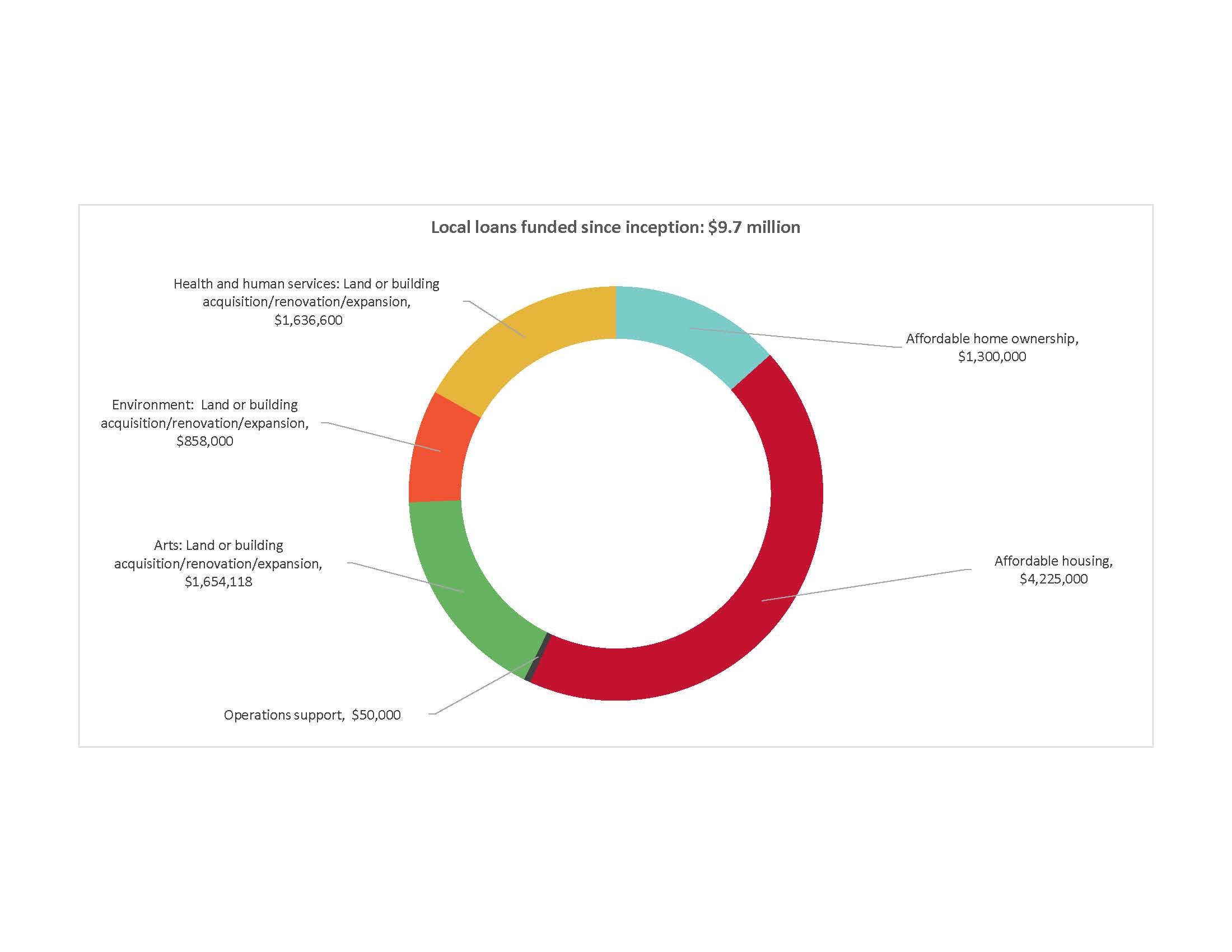
Local loans since inception total $9.7 million with $7.1 million outstanding at year end. Chart 6 shows the impact areas our loans have supported. Since the loan program’s 2012 inception, $2.6 million in loan principal has been repaid and recycled as new loans. In addition, the interest from these loans supports HCF granting.
Chart 6
IRP is a Government of Canada program being delivered nationally by partners including Community Foundations of Canada. As the first phase in the government’s long-term investment in social finance, the IRP’s goal is to make social-purpose organizations “investment ready” so they can make a difference in new and innovative ways through their participation in the social finance market. HCF has partnered with community foundations in London and Niagara, and the McMaster Innovation Park to manage the program regionally on behalf of Community Foundations of Canada. The first request for proposals for funding in January created enormous interest nationally and garnered 65 submissions to our regional partnership. Approved funding is expected to be released in June 2020. As an additional benefit, the IRP brought a growing number of potential opportunities for local loans to HCF’s attention.
These investments include private equity, private debt and real estate investments. Many of these investments are long term in nature, are maintained at cost and do not have a regular income stream. As these investments are maintained at cost, their results include interest income and realized gains, but not unrealized gains. Results for these investments are closely monitored and are reported when realized. Chart 7 identifies the investment areas, with $18.0 million placed and a total commitment of $33 million across 21 investments.
Chart 7
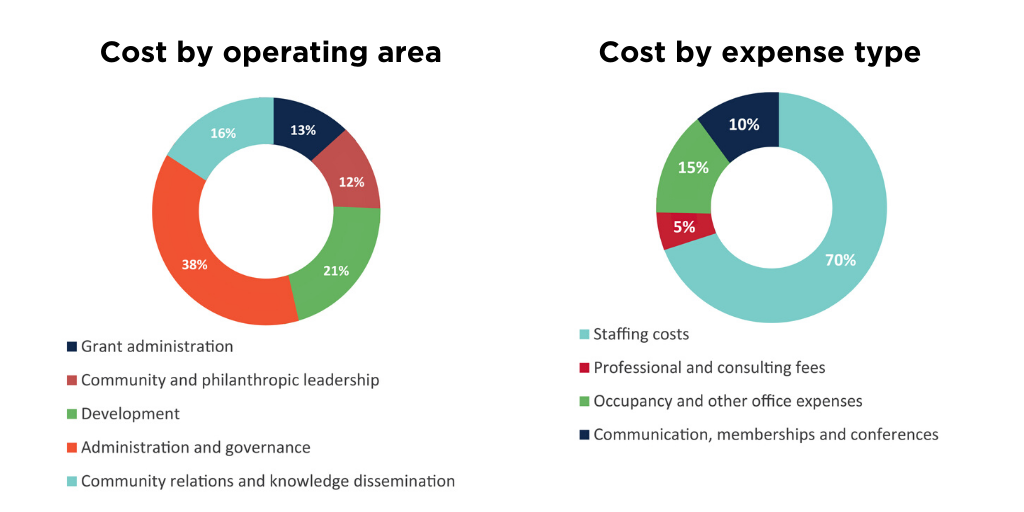
Operating expenses for the fiscal year ended March 31, 2020 total $2.5 million and were 2.5 percent higher than last year. Staffing costs related to the Foundation’s 22 employees represent 70 percent of HCF operating costs.
In addition to breaking out cost by type, operating costs are allocated to each of the Foundation’s operating areas: grants administration, community and philanthropic leadership, community relations and knowledge dissemination, development activities, and administration and governance. Examples of community and philanthropic leadership include convening around the city’s critical issues and fostering the growth of philanthropy by sharing staff time and knowledge to support other charities. Charts 8 and 9 illustrate these costs by operating area and by expense type.
Charts 8 and 9
The Foundation’s annual development expenses are not necessarily attributable to the donations received in that year. The nature of donations to the Foundation can result in costs preceding the receipt of the donation by several years (for example, donations through wills). As a result, consistent with the community foundation sector, operating costs are evaluated by a ratio of total operating expenses to average total assets. Ratios fall within a range depending on the size and stage of the community foundation’s development.
Management considers the ratio of 1.26 percent (1.25 percent in 2019), as illustrated in Chart 10, to be within an acceptable range for a foundation of HCF’s size, stage and level of community leadership, compared against benchmarks established in the community foundation sector. We continue to monitor both the actual results and the benchmarks on an ongoing basis.
Chart 10

Hamilton Community Foundation’s total assets of $201 million at March 31, 2020 include balances of HCF funds and funds held on behalf of others at $1.7 million.
Hamilton Community Foundation’s fund balances, illustrated in Chart 11, represent accumulated donations plus the net investment earnings on these donations, minus granting and operating costs. Funds include both endowed and flowthrough funds. Endowed funds are held permanently and grant from investment earnings. Flowthrough funds are fully distributed as grants over a pre-determined term.
Chart 11
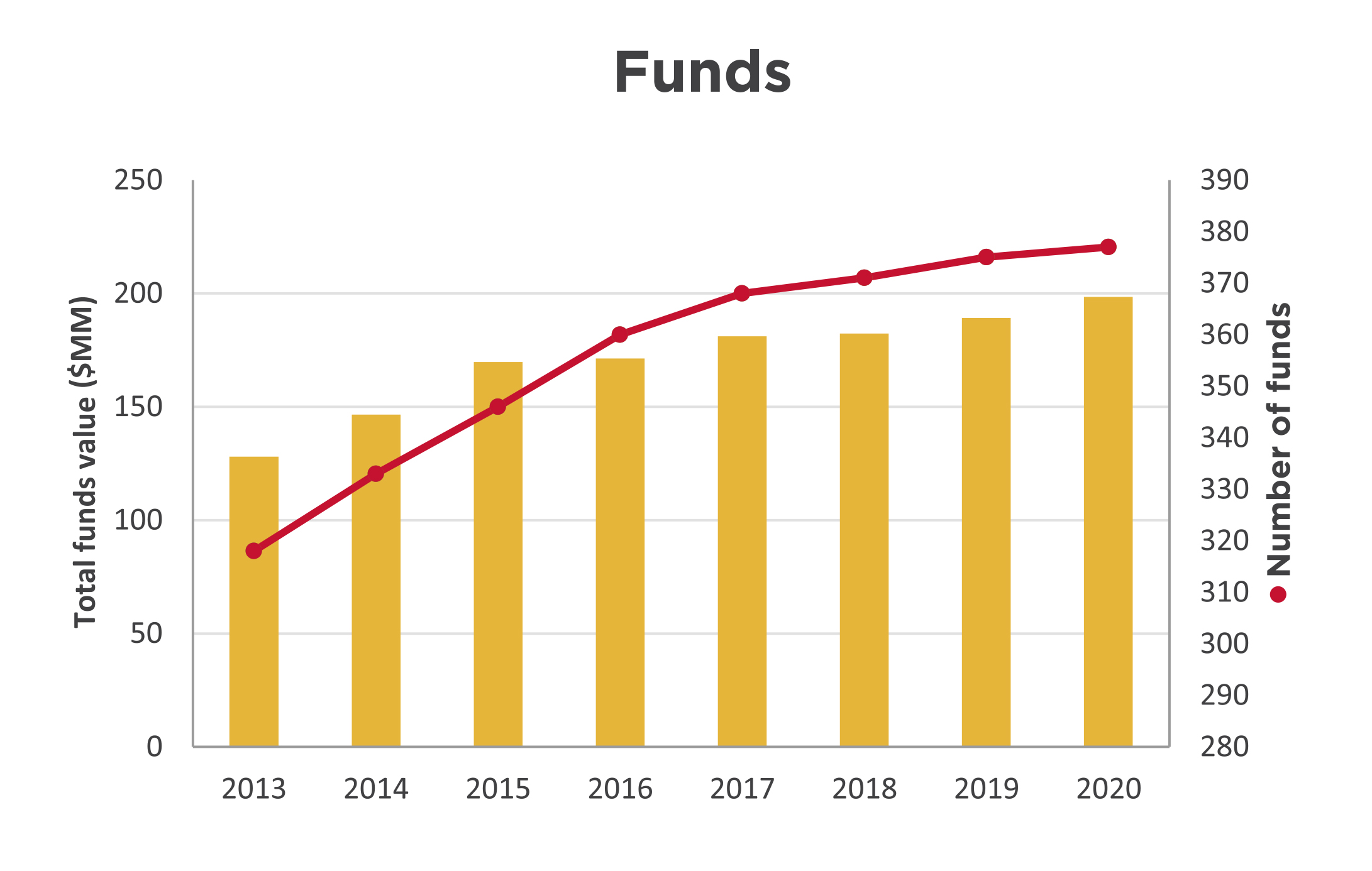
The fund balances have grown 55 percent to $198 million at the year ended March 31, 2020 from $128 million in 2013. Donations of $35.1 million included $4.4 million in flowthrough donations that were largely distributed as grants in the year and, as a result, do not remain in the fund balances at year end. This results in a modest total funds balance growth of 4.8 per cent for the year. The number of funds has grown 19 percent to 377 from 318 in 2013.
 Donate Today